
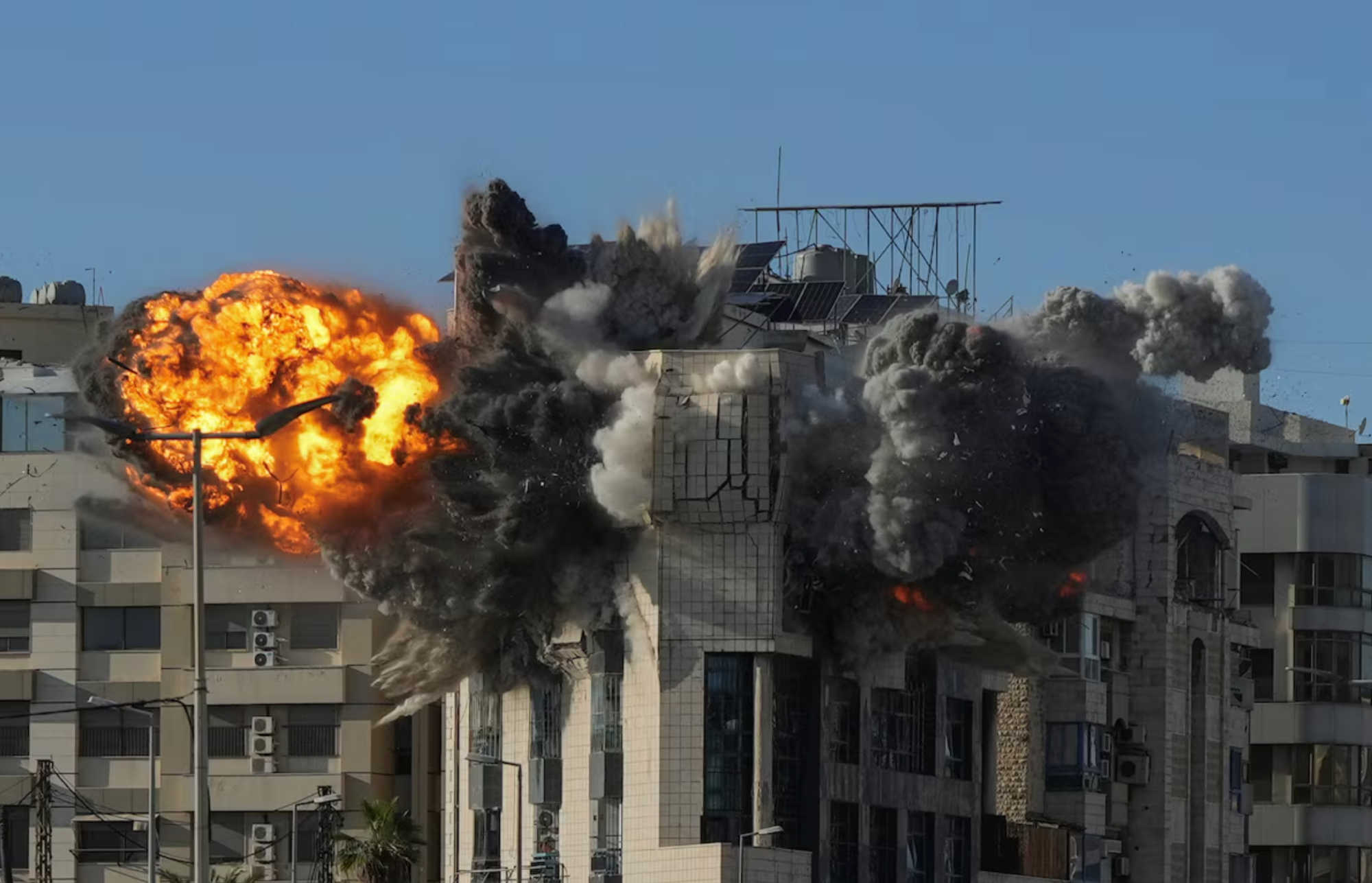
A blast rips through a building in Beirut, Lebanon, after an Israeli strike on Tuesday.
Ahead of a prime-time address on Iran, President Donald Trump is signaling a narrower path to claiming success, even as Tehran and Israel continue trading blows, Gulf energy infrastructure remains battered and under threat, and governments across the world scramble to blunt the fallout from the war-driven oil and gas shock.

As of Wednesday morning, President Donald Trump had not yet delivered his planned national address on Iran. The White House said he would speak at 9 p.m. EDT, but his position heading into the speech had already shifted in a notable way. After offering varying war aims that ranged from toppling Iran’s government to weakening its military and regional influence, Trump said Tuesday that U.S. operations could end “within two weeks, maybe two weeks, maybe three,” and that Iran does not need to make a deal with Washington for the fighting to wind down. Instead, he said the United States would leave once Iran was so weakened that it could not soon acquire a nuclear weapon.
That message — a shorter, narrower endgame without a formal diplomatic settlement — comes even as the war remains active on multiple fronts. The conflict began on February 28, when the United States and Israel attacked Iran, and that Tehran responded with attacks on Israel and Gulf states hosting U.S. bases. Fresh attacks were still being reported on Wednesday, including drones hitting fuel tanks at an international airport and a tanker struck off Doha, underscoring how unstable the battlefield remains even as Washington talks more openly about a possible exit.
Iran, meanwhile, continues to absorb strikes while still showing an ability to hit back across the region. Gulf Arab states told the United Nations that Iranian drone and missile attacks on energy and civilian infrastructure had become an “existential threat” to regional and international security. Those attacks have included strikes on Gulf energy assets after Israel hit Iran’s South Pars gas field, a major escalation that sent oil prices sharply higher. The White House said last week that the U.S. military was prepared to thwart any attacks after the Islamic Revolutionary Guard Corps threatened American companies in the region, widening the war’s target set beyond the battlefield and into the corporate sphere.
The economic damage has been global. Reuters reported that both Brent and U.S. crude benchmarks had gained about 60% since the war began, that the International Energy Agency has released a record 400 million barrels from strategic stockpiles, and that analysts now see prices staying elevated even under de-escalation scenarios if the Strait of Hormuz remains disrupted. That shock has rippled into inflation, shipping, manufacturing and household fuel costs around the world.
Governments have responded in different ways. South Africa said it would temporarily cut its fuel levy by 3 rand per litre for one month and is working on a broader support package for households and key sectors. Indonesia said it may need up to 100 trillion rupiah in additional energy subsidies this year because of the war. Germany approved initial steps to curb fuel-price surges by allowing petrol stations only one price increase a day, while also considering more relief, including lower truck tolls and a VAT cut at filling stations. India, facing what has been described as its worst gas crisis in decades, cut industrial gas supplies to shield households, kept domestic cylinder prices unchanged, increased daily LPG production, and secured 800,000 tons of cargoes from the U.S., Russia, Australia and elsewhere.
China has taken a different path. Beijing is better insulated than many of its neighbors because of years of stockpiling, diversified imports, rapid electric-vehicle adoption and a power grid less exposed to foreign fuel imports, while also noting an unofficial ban on fuel exports to conserve supplies. Japan, one of the countries most exposed to Gulf disruption, has also moved to release oil from its reserves to soften the blow.
At the center of the global energy emergency is the Strait of Hormuz. Before the war, it was one of the world’s most important open shipping arteries for oil and gas. The straight, however, is now effectively shut and under Iranian control, with Gulf exports badly disrupted and only a trickle of negotiated passages making it through. China confirmed that three ships had recently transited the strait after coordination with “relevant parties,” while Reuters reported that a small number of Indian-flagged LPG tankers and a Greek-operated tanker carrying Saudi crude also made it through. But most traffic remains choked off.
Associated Press reported last week that Iran is moving toward a de facto “toll booth” regime in the strait, that parliament was working to codify toll collection, and that some ships had reportedly paid in Chinese yuan for passage.
Another flashpoint now hanging over the wider war is Israel’s new death-penalty law. The state's parliament passed a law making death by hanging a default sentence for Palestinians convicted in military courts of deadly attacks. The U.N. rights chief said the law was “deeply discriminatory” and violated international humanitarian law, while the European Union called it “a clear step backwards.” Critics and legal experts say the law would not in practice apply equally to Jewish Israelis, which is why it has drawn such sharp condemnation.
All of that leaves Trump heading into Wednesday night’s address with a difficult case to make. Markets have rallied on hopes that the war may be nearing a turning point, but the conflict is still live, Tehran is still striking back, Gulf states are still under pressure, Hormuz is still constrained, and the oil-and-gas shock is still forcing governments into emergency measures. The most important question in the speech may not be whether Trump says the war can end soon. It may be whether events on the ground still allow him to define that as victory.



Advertisements