
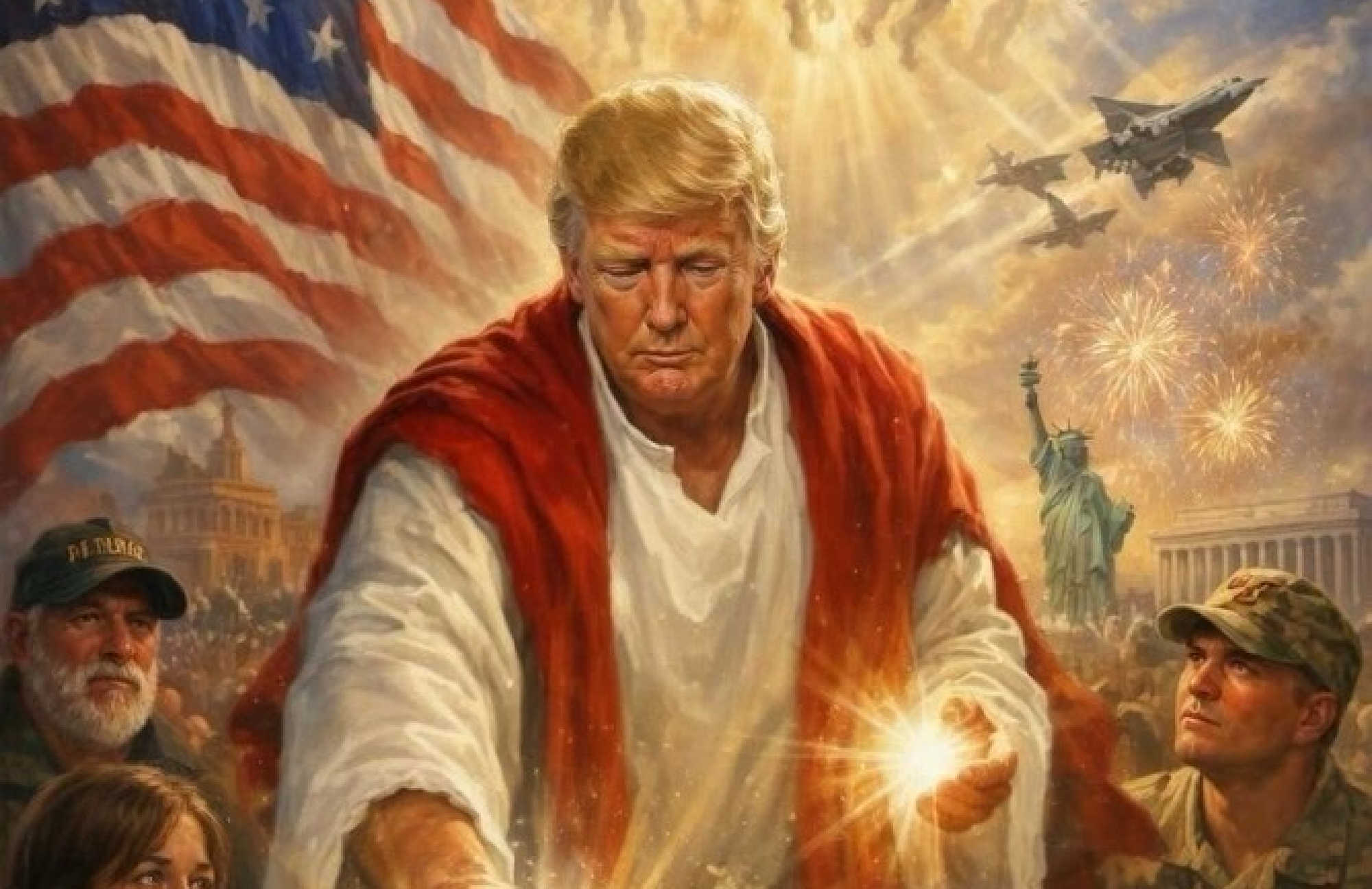
An AI-generated image shared by President Donald Trump on Truth Social depicts him in a Christ-like role healing a man, intensifying backlash during his public feud with Pope Leo and the wider Iran war crisis. Photo Credit: TRUTH SOCIAL.
The newest turn in the U.S.-Israel war against Iran came after weekend talks in Islamabad collapsed and Washington responded not with a new diplomatic offer, but with a maritime squeeze. The U.S. military said it would begin blocking shipping entering or leaving Iranian ports and coastal areas, a move that sent Brent crude back above $100 a barrel and renewed fears about inflation, freight and energy costs worldwide.

The blockade stops short of a full U.S. shutdown of the Strait of Hormuz, and that distinction is important. U.S. Central Command said ships traveling through Hormuz to and from non-Iranian ports would still be allowed to pass. But tankers were already steering clear of the waterway, and Trump said any vessel paying tolls to Iran would be intercepted. Iran’s Revolutionary Guards warned that any military approach to the strait would violate the two-week ceasefire and draw a forceful response.
The diplomatic breakdown in Pakistan is now central to the situation. The Islamabad talks — the highest-level direct U.S.-Iran negotiations since 1979 — failed over U.S. demands that Iran end all uranium enrichment, dismantle key enrichment facilities, transfer out highly enriched uranium, curb support for Hamas, Hezbollah and the Houthis, and fully reopen Hormuz. Iran rejected those terms. Iran Foreign Minister Abbas Araqchi accused Washington of “maximalism, shifting goalposts, and blockade” when the two sides were “just inches away” from what he called an “Islamabad MoU.” He added, “Zero lessons learned. Good will begets good will. Enmity begets enmity.”
At the same time, Trump opened another front in the crisis by escalating his feud with Pope Leo, one of the most prominent religious critics of the war. Trump attacked the pope as “terrible” and “weak on crime and foreign policy” after Leo condemned the conflict and described Trump’s earlier threat against Iranian civilization as “unacceptable.” Pope Leo answered Monday by saying he would continue speaking out against war and warning that the Gospel must not be “abused.” “I will continue to speak out loudly against war,” he told reporters, adding that peace and dialogue must remain the objective.
The clash widened further when Trump posted an AI-generated image depicting himself in a Christ-like role, healing a man. The post appeared after his public attack on Pope Leo and immediately added another layer of controversy to a dispute already centered on war, religion and presidential rhetoric.
The market reaction shows how little room there is for new brinkmanship. Oil jumped more than 7% after the blockade move, with Brent trading above $100 as traders priced in the possibility of deeper disruption around Hormuz. That matters far beyond the Gulf. Higher crude means higher transport costs, higher fuel bills and more inflation pressure, especially in places already exposed to imported energy and imported goods.
The diplomatic strain is no longer limited to Washington and Tehran. A public feud is now intensifying between Turkish President Recep Tayyip Erdogan and Israeli Prime Minister Benjamin Netanyahu after Erdogan warned against efforts to sabotage the Iran ceasefire and Netanyahu answered by vowing to continue fighting Tehran and its regional allies. Meanwhile, any attempt by Washington to internationalize its maritime pressure is still running into resistance: Germany, Spain and Italy have ruled out joining a Gulf mission for now, and Britain has separately said it will not take part in a U.S.-led blockade of Hormuz.



Advertisements