
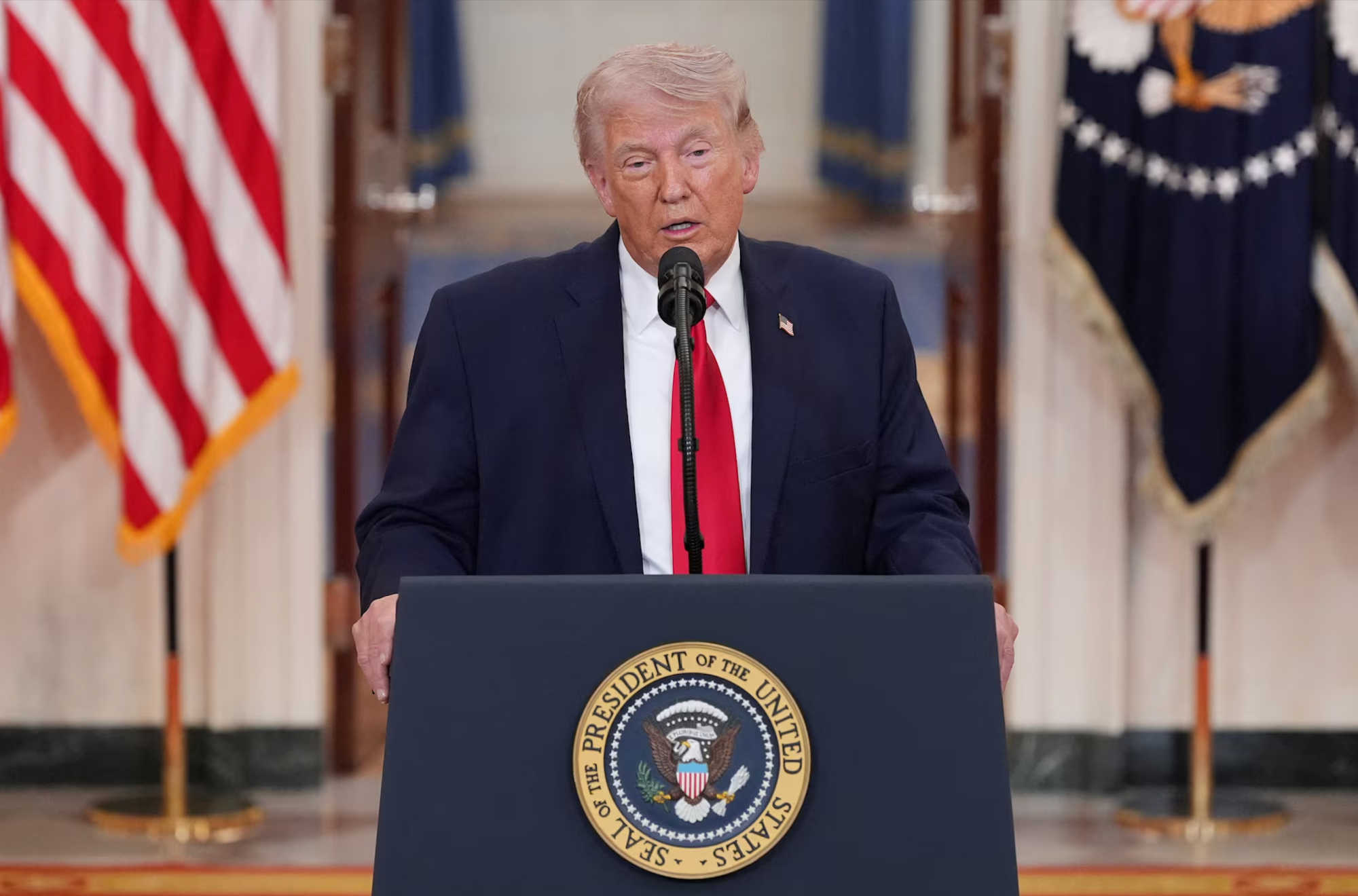
President Donald Trump addressed the nation on Wednesday, outlining his administration’s position on the war with Iran as tensions continued to roil global energy markets and the broader Middle East.
President Donald Trump used his national address on Wednesday to portray the U.S.-Israeli war on Iran as a campaign nearing success, saying America had crippled Iran’s navy, air force, missile capability and nuclear program and could wind down operations within two to three weeks. But that message collided with a harsher reality: the Strait of Hormuz remained under Iranian leverage, oil stayed above $100, Tehran was still striking Israel and Gulf states, and scrutiny was mounting over attacks on civilians and civilian infrastructure.

The speech continued a broader shift in Trump’s war messaging. The administration’s stated objectives have moved over time, with Trump at various points hinting at broader political change in Iran while later narrowing his public case to degrading Tehran’s military and nuclear capacity and leaving “pretty quickly.” By Wednesday night, he was again claiming the core objectives were nearly complete, even as he paired that with threats to bomb Iran “back to the Stone Age” and offered no firm timetable for when the fighting would actually end.
One of the sharpest contradictions in Trump’s address concerned the Strait of Hormuz. Before the war that began on Feb. 28 with joint U.S.-Israeli strikes on Iran, the strait was one of the world’s most important open shipping routes for oil and gas. Now Iran has a chokehold on the waterway, tanker traffic has collapsed, and the closure has helped create what reports described as the worst global energy shock in history. Trump nevertheless said countries that depend on Gulf oil should “take the lead” in reopening the route because the United States does not rely on those supplies in the same way. Britain, meanwhile, was preparing a 35-nation diplomatic meeting on how to restore freedom of navigation, underscoring that the strait has become a global problem even as Trump tried to argue it should not be America’s burden.
The economic fallout has deepened, not eased. After Trump’s speech, Brent crude jumped back toward $108 a barrel, while the International Energy Agency believes more than 12 million barrels of oil have already been lost since the war began and that the supply shock is set to hit Europe harder in April. The IEA, IMF and World Bank have formed a coordination group to respond to the widening damage. Governments are already taking defensive steps: Japan has started using oil reserves, South Africa cut its fuel levy for one month, and India has raised jet fuel and commercial LPG prices while diverting supply to protect households.
On the battlefield, Iran showed on Wednesday that it remains able to retaliate across the region. Associated Press reported that Tehran fired missiles at Israel and several Gulf neighbors after Trump spoke of winding the war down, with strikes intercepted over Dubai, Israel and Bahrain, which hosts the U.S. Navy’s 5th Fleet. Reuters has separately reported that Iran has continued firing at targets in Gulf Arab states, where the United States has military bases, and has also struck merchant shipping and other energy-linked targets tied to the regional supply system. That continued reach is one reason analysts have warned that a war meant to break Iran could instead leave Tehran strategically stronger and Gulf states more exposed.
The conflict has also widened into the corporate and technology sphere. Amazon Web Services data centers in the United Arab Emirates and Bahrain were damaged by drone strikes, marking the first time a major U.S. tech company’s data-center infrastructure in the region had been disrupted by military action. Later, Iran’s Revolutionary Guards threatened 18 U.S. companies operating in the region, including Microsoft, Google, Apple, Intel, IBM, Tesla and Boeing, and the White House said the U.S. military was prepared to thwart any attacks on American corporate interests.
At the same time, humanitarian agencies and rights officials have documented mounting damage to civilian life and civilian infrastructure. The U.N. human rights chief has pressed Washington to finish and publish the results of its investigation into a strike on Iran’s Shajareh Tayyebeh School, which Tehran says killed more than 175 children and teachers. WHO said on March 18 that it had verified 20 attacks on health care in Iran, with nine deaths, while a U.N. briefing on March 26 cited reported damage to more than 600 schools, 289 health facilities, 17 Red Crescent centres, three helicopters and 48 emergency vehicles in Iran.
Those reports have sharpened questions about the lawfulness of how the war is being fought. In a March 3 statement, the U.N. human rights office said attacks directed against civilians or civilian objects, as well as indiscriminate attacks, are serious violations of international humanitarian law and may amount to war crimes. Reuters, in a separate explainer, noted that the Geneva Conventions require parties to distinguish between civilian objects and military objectives, and that any war-crimes determination in a specific strike would turn on evidence of distinction, proportionality and military necessity. Prosecutions are unlikely soon because none of the main states involved — including Iran and Israel — are ICC members, and Security Council divisions make referral improbable.
Taken together, Trump’s speech looked less like a clean declaration of victory than an attempt to impose one. He argued that the United States is winning and close to finishing the job. But Tehran continues to hit back, Hormuz remains constrained under Iranian leverage, the oil shock is still feeding inflation and market turmoil, and the war’s civilian and legal toll is drawing growing international alarm. The central political problem for Trump after Wednesday night is that he tried to define the conflict as almost over while nearly every major indicator — military, economic and humanitarian — suggested it is still widening.



Advertisements