

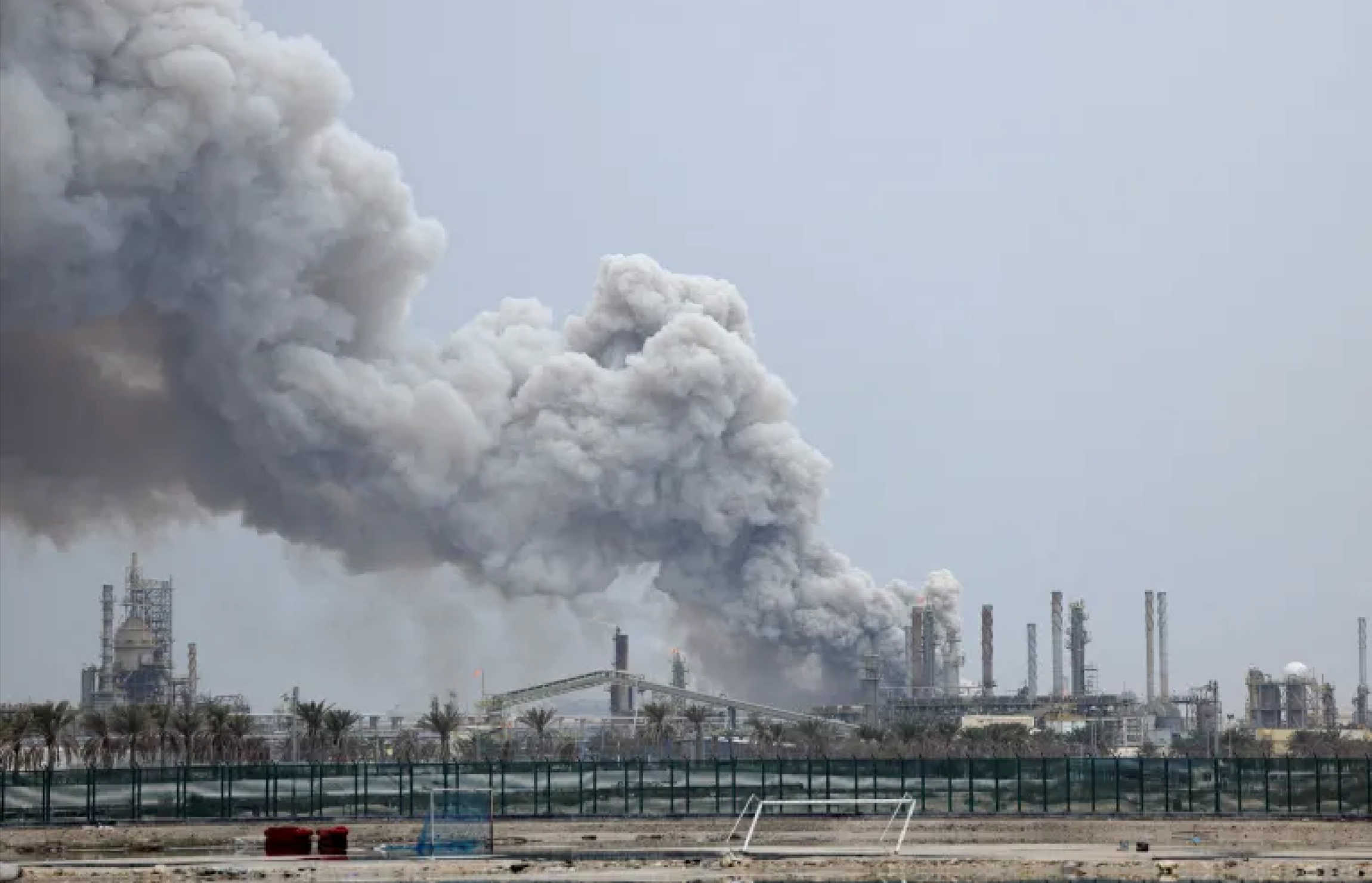
Smoke billows above Bahrain’s Bapco refinery on Sitra Island after a strike on March 9, 2026.
A month into the U.S.-Israel war against Iran, talk of $150 oil is no longer fringe and talk of $200 oil has entered the policy debate, even if U.S. Energy Secretary Chris Wright told Reuters that $200 a barrel remains unlikely. Brent crude has already climbed nearly 60% in March to about $115.66 a barrel, while Morgan Stanley said oil staying in a $150-$180 range could slash global equity valuations by as much as 25%. Reuters also reported that Macquarie sees crude rising to $150 a barrel or more if the Strait of Hormuz remains shut for several weeks.

The conflict at the center of those warnings began on Feb. 28, when the United States and Israel launched strikes on Iran. Today, the Strait of Hormuz remains largely closed, with roughly 12 million barrels a day still unavailable and global oil and LNG supply chains moving toward what its analysts called a crisis scenario.
For the U.S. Virgin Islands, the danger is real. The territory’s own 2024 Energy Security Plan says the USVI is 100% dependent on outside suppliers for its petroleum supply, that more than 90% of its energy is still sourced from petroleum, and that roughly 80% of its petroleum supply is used to power the electric grid and WAPA’s desalination plants. The plan also says the territory is highly dependent on shipping and transoceanic cargo for energy supply and internal fuel distribution.
The same pattern exists with food. The V.I. Department of Agriculture says roughly 97% of the territory’s food is imported from elsewhere. That means an oil shock does not stop at the gas station. It works its way into freight, supermarket shelves, water production, electricity generation, and the cost of getting nearly every essential item into homes and businesses.
Local motorists are already paying steep prices. In the latest official DLCA survey surfaced on the department’s site, self-service regular averaged $4.099 on St. Croix, $4.699 on St. Thomas, and $5.199 on St. John. Those prices are already well above many mainland markets before any full $150 or $200 crude scenario is reached.
To estimate where USVI gas prices could go, the most useful official rule of thumb comes from the U.S. Energy Information Administration, which says a $1-per-barrel change in crude oil typically translates into about a 2.4-cent-per-gallon change in gasoline. Using Reuters’ current Brent reference of about $115.66, moving to $150 implies an increase of roughly 82 cents a gallon, while moving to $200 implies an increase of about $2.02 a gallon if the change is fully passed through.
Applied to the latest official island fuel averages, that would put regular gasoline at roughly $4.92 on St. Croix, $5.52 on St. Thomas, and $6.02 on St. John if oil reached $150. At $200 oil, the same method yields about $6.12 on St. Croix, $6.72 on St. Thomas, and $7.22 on St. John. Those are estimates, not forecasts, and real-world prices could come in lower or higher depending on retail markups, shipping costs, refinery margins, and the pace at which local sellers pass through higher crude prices.
There is another complication in the Virgin Islands: the territory already carries structural costs that mainland drivers often do not. The Energy Security Plan emphasizes geographic isolation and reliance on imported fuel. That means higher crude prices arrive here layered on top of smaller-scale distribution, marine transport, storage, and island-specific operating constraints. In other words, the territory’s elevated baseline is already the geography premium.
And because the USVI imports almost all of what it eats and most of what it uses, the next wave would likely show up in grocery aisles and household bills as well. According to several reports, the war’s energy shock is now pushing up not only oil and gas, but also fertilizers and other essentials, while Germany’s inflation data have already begun to show the first pass-through from higher energy costs. For the Virgin Islands, where imported food dominates, that is a warning sign.



Advertisements