
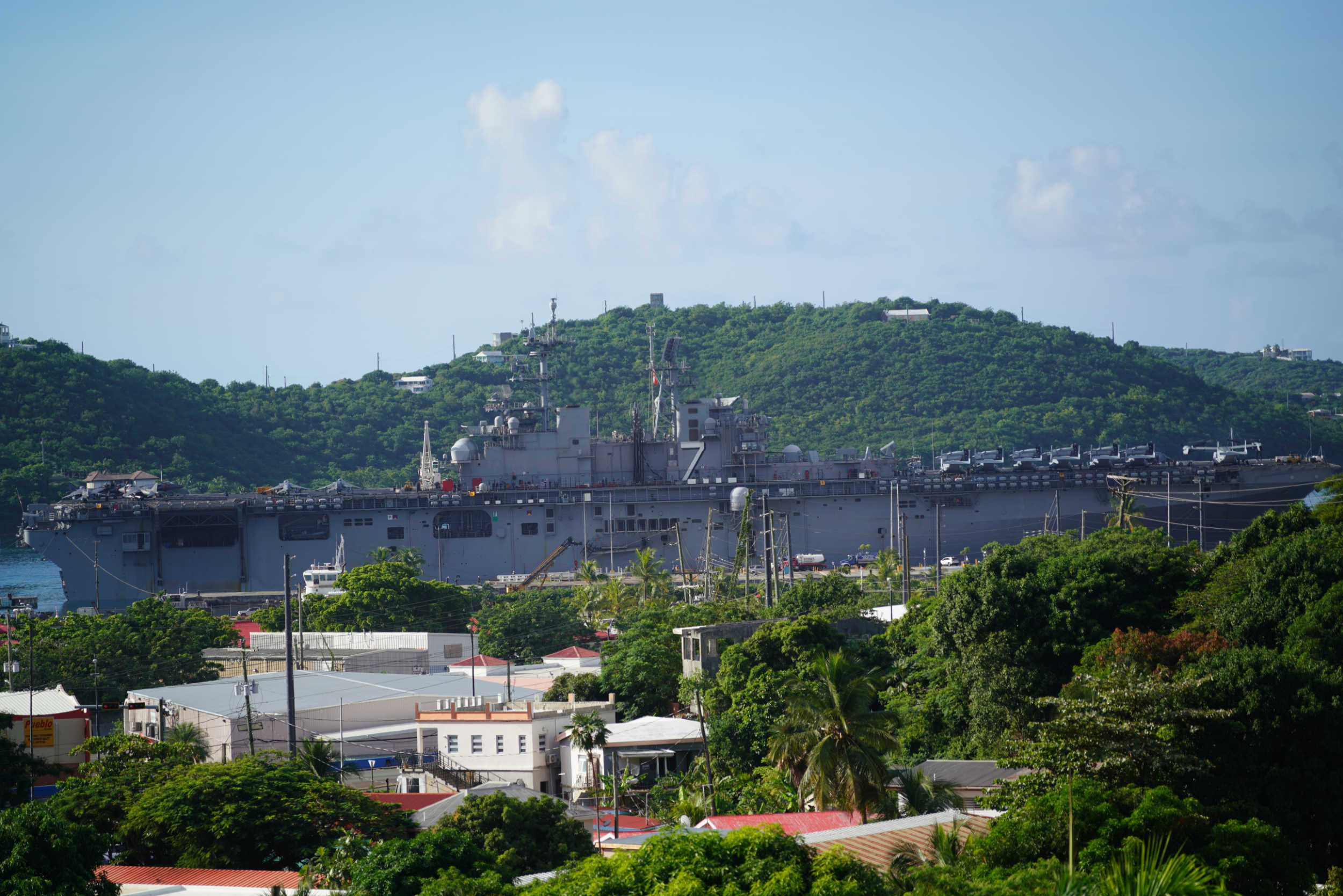
The USS Iwo Jima, a U.S. Navy amphibious assault ship, docked at the Austin Monsanto Marine Terminal in Crown Bay, St. Thomas on Friday, Oct. 3, 2025. Photo Credit: DEAR PRODUCTIONS.
Joseph Boschulte, former commissioner of the V.I. Department of Tourism and now chief executive officer of the West Indian Company Limited, told lawmakers this week that the January 3 U.S. military operation in Venezuela—resulting in the capture of President Nicolas Maduro and his wife—has already begun affecting Caribbean tourism and could further unsettle traveler confidence across the region.
The operation temporarily impacted travel throughout the Caribbean, where tourism is considered the lifeblood of nearly every nation. Concerns have also grown that potential visitors could be dissuaded from traveling to the Caribbean amid fears of additional military action and broader instability.
Those concerns were raised Wednesday during a meeting of the Committee on Economic Development and Agriculture, when Senator Marise James sought Boschulte’s perspective. “I think the region is fragile with what's going on in Venezuela,” the senator observed.
Boschulte confirmed her concerns. “We are concerned,” he said, informing the committee that a cruise call was lost “as a direct result of the Venezuela situation” because passengers were unable to travel to San Juan to board the ship.
The timing of the disruption was particularly troubling for the territory, Boschulte said, noting that Saturdays account for the bulk of arriving flights. For him, it was the “worst day to happen.”
According to Boschulte, the Caribbean has long been regarded as “the safe region, particularly for cruising vacation.” Outside of the invasion of Grenada in 1983, military action—apart from an increased presence in 2025—has been practically unheard of.
He cautioned that heightened uncertainty could shift traveler behavior. “Then there is a concern, because if people get more conservative, it doesn't mean they won't take vacations; it means they say, ‘hey, let's just stay under the friendly confines of the continuous United States,’” Boschulte said. He anticipates that travelers seeking tropical destinations could instead opt for the Western Caribbean or southern Florida.
Boschulte said the success of the Caribbean’s tourism sector depends on peace of mind. “People have to feel that they could come to the region and to us, the territory, and get back when they supposed to get back,” he said.
While acknowledging the risks, Boschulte said he is attempting to remain optimistic, expressing hope that travelers who still plan to visit the Caribbean will feel comfortable choosing the U.S. Virgin Islands because it is “under the US flag.” At the same time, he noted the perceptions that may persist among potential visitors. “As long as the appearance of conflict is in the region, there is potential risk that not as many people will come,” he warned.

Boschulte’s assessment prompted a sobering response from Senator James. “We can no longer think that we're not affected,” she said.


Advertisements