
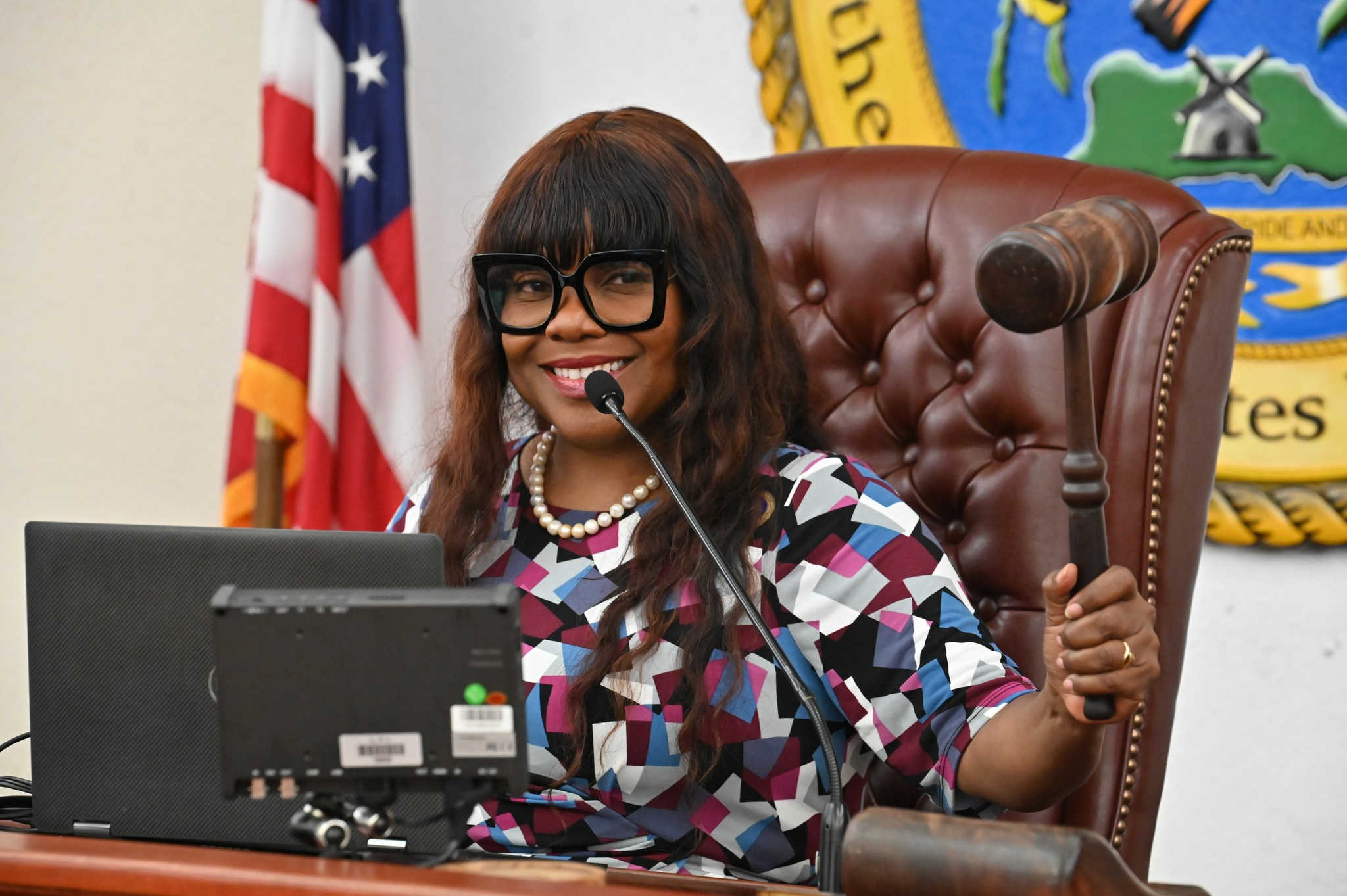
Senator Carla Joseph. Photo Credit: V.I. LEGISLATURE.
Two bills authored by Senator Carla Joseph were both held in the Committee of Government Operations, Veterans Affairs, and Consumer Protection after calls for further refinement.

The first, Bill 36-0113, would assign liability to businesses that serve intoxicating beverages to patrons who have overconsumed. Joseph stated that the bill addresses the “devastating consequences of drunk driving in the Virgin Islands” and protects “innocent lives, promoting responsible alcohol service and ensuring justice for victims.” She argued that existing laws “fail to address the role of businesses that profit from over-serving alcohol to visibly intoxicated patrons.”
If enacted, a victim of a drunk driving accident could commence proceedings against a server who provided alcohol to a person who was already drunk.
The Department of Licensing and Consumer Affairs generally supported the bill, with Commissioner Natalie Hodge noting that the current law is “outdated and difficult to apply in practice.” The existing standard is that a claimant must prove that a server provided alcohol to a person habitually addicted to alcohol. For Hodge, Senator Joseph’s proposal “appropriately replaces the archaic standard with a more practical and commonly understood one.”
Ms. Hodge suggested that servers should obtain responsible alcohol service certification that teaches them, in part, how to identify “visible signs of intoxication.” The commissioner noted, however, the difficulties in assigning responsibility if an individual has been bar hopping.
The same level of support was not offered by Hugo Hodge, a local business owner. He contended that the bill attempts to “shift personal liability and culpability from the person that's making the decision to consume alcohol to the business owner.”
Mr. Hodge also questioned the determining factors for visible intoxication. “Who can define that? Who can set a standard for that? Who can say that?” he asked. “It seems utterly impossible to even assess…How are they to know what level of alcohol intake that person has had before they got to that business?”
The second measure, Bill 36-0115, would authorize the Department of Licensing and Consumer Affairs to physically close a business when it finds that the business is causing a nuisance, presents a threat to safety or is disturbing the peace. According to Senator Joseph, the bill empowers the DLCA to “take decisive action” against businesses that disturb the peace.
She lamented that several neighborhoods have become “hubs of noise and disruption due to the unchecked proliferation of bars and restaurants” which has resulted in a “decline in the quality of life of many of our homeowners, as well as residents.” She assured that the bill was not about “stifling the businesses” but “ensuring that businesses operate responsibly while safeguarding the rights of the residents.”
The DLCA supported the intent of the bill, noting that the department’s current enforcement framework “relies largely on administrative proceedings that require notice and a hearing before sanctions may be imposed.” This arrangement impedes DLCA from acting quickly when nuisances are reported by the public. Hodge agreed that the bill would help “address the gap” but proposed several recommendations to strengthen the proposal.
Rashida Francis, who spoke on behalf of residents of several communities, including Old Tutu, Estate Thomas, Bovoni, and Hidden Valley, supported the measure. She spoke of the impact of noise from neighboring establishments on the community, particularly children, seniors, and those with sensory challenges. Ms. Francis shared that while residents often contact the V.I. Police Department, officers “do not always show up with a device to measure noise, as stipulated by the law.”
“They do ask business owners to turn the music down in an effort to maintain peace, [but] as they leave, some businesses turn the sound back up,” Ms. Francis explained. She cited the existing noise ordinance and various requirements that businesses must fulfill as part of the licensing process. Ms. Francis urged greater enforcement. “Residents are not asking for businesses to shut down. Residents are asking for the law to work as intended,” she stated.
On the second measure, Mr. Hodge suggested that the Legislature may be responsible for some of the current nuisances, “because some variance was granted by this body [during the] time of your predecessors.”
The reviews from lawmakers were mixed on both measures. Senator Ray Fonseca stated that he supported both. On Bill 36-0113, the committee’s chair, Senator Avery Lewis, suggested incorporating grocery stores as those who sell alcohol have “people sitting down in front of them consuming it all day long.” Senator Joseph later clarified that the bill is “broad” and therefore can be applied across the board.
Senator Alma Francis Heyliger was unsure about the ability to appropriately enforce Bill 36-0113 and hold servers accountable. “You don't know if that person stopped by a grocery store and picked up another bottle. How do we enforce this?” she asked.
“I understand what we're trying to do here, but there's a lot more to be done before we could get this done,” agreed Senator Franklin Johnson, who felt that Bill 36-0113 was “unfair to any establishment.”
“We have to find ways to adjust both of these measures,” he said. Senator Kenneth Gittens agreed. He argued that Bill 36-0113 “creates strict liability without practical standards.” He added that the bill goes “beyond negligence and clearly into speculation.” On Bill 36-0115, he suggested that the terms are“ vague and subjective” and need to be defined.

Senator Joseph agreed to consider the recommendations made during Monday’s meeting, and moved to hold both bills in the committee. Senator Gittens has pledged to work with her, noting that “good policy must be enforceable, fair and clearly defined.


Advertisements