

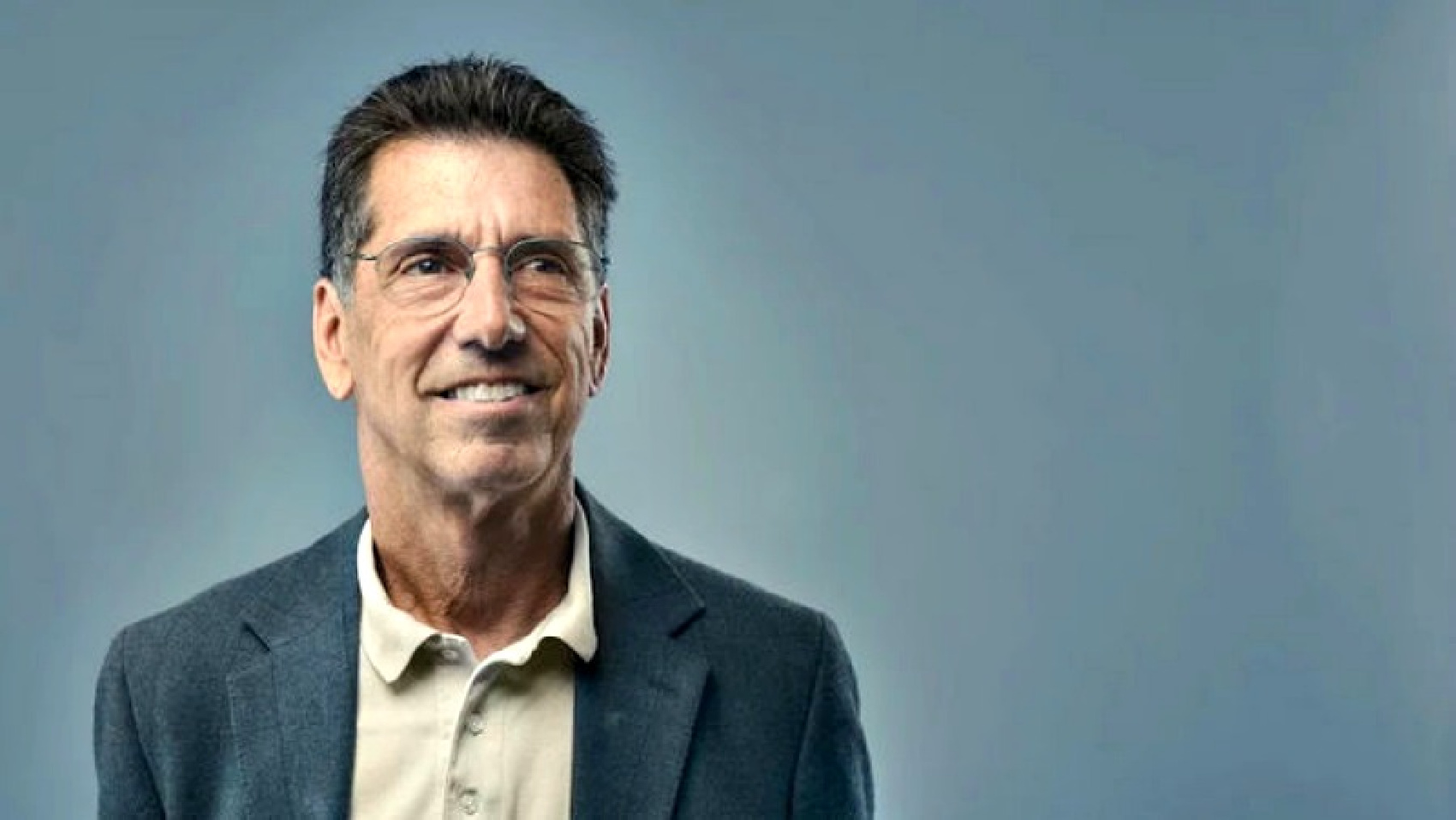
Gubernatorial Candidate Warren Mosler. Photo Credit: V.I. CONSORTIUM.
Warren Mosler, announcing his bid for governor on the V.I. Consortium Wednesday, says his campaign is built around a straightforward pledge: he wants to put large cash payments directly into the hands of Virgin Islands voters—on the scale of $20,000 to $25,000 per person—whenever he identifies major pools of money he believes the territory can capture outside its normal tax structure. Mosler said he intends to establish a citizens dividend fund and use it to make payouts to people who vote, describing the effort as an extension of what he says has been his life’s work—making money for other people.

Mosler described the payments as something he wants to do “as often as possible,” framing it as his job if elected. He also described the dividend as an annual concept patterned after Alaska’s citizens dividend, which distributes funds tied to oil and gas revenue. Mosler said he would move quickly once meaningful money is secured. “Well, I'll pay it out right away,” he said, adding that “soon as it's serious money, we'll pay it right out.”
In Mosler’s plan as he outlined it, the regular operations of the Virgin Islands government would continue on existing revenue, money he suggested should be sufficient if paired with transparency and a reduction in corruption. Additional revenue streams, he contends, would be routed into a separate pool meant for direct payments. He said the territory could run well on the roughly billion-dollar scale it already has, and that his dividend approach would rely on money the government does not typically secure unless someone goes out to bring it in.
Mosler’s renewed push for office, he said, was sharpened by what he views as a missed opportunity surrounding Jeffrey Epstein’s estate. He said that when Epstein died there was $586 million in the estate, and he said he contacted Governor Albert Bryan Jr. and urged him to place what Mosler called an “IRB lien” on the estate. Mosler described that as a tax lien approach that, in his view, would have put the territory in position to claim the money.
He said the basis for the lien, as he proposed it, was that Epstein had misrepresented his business and that the territory could respond by disallowing deductions and benefits it had granted over “the last 30 years, whatever it is,” then adding interest and penalties. Mosler said that, under his reasoning, “the whole $586 million is our money returned to us.” He said the governor responded, said he would look into it, but ultimately did not do it.
Mosler said he later returned to the issue, including discussing it with friends who believed they could help push for action. He said he and others met with the governor, and Mosler recalled questions raised about what happens if the government places a lien and turns out to be wrong. Mosler argued there is no penalty in the scenario he described, comparing it to tax authorities placing liens and later walking away. In his telling, the administration still did not move forward.
Mosler said he was later told the administration chose to work through the Justice Department and pursue a lawsuit approach instead. Mosler criticized that decision, saying it was “much more difficult,” and would recover only “a fraction of the money,” and would not place the proceeds into the general fund. He said such money would go to victims and similar ends. Mosler said he did not oppose victims receiving money, but argued the territory should first secure the full amount and then decide, through the Legislature, how any portion should be distributed. In the interview, he described the alternative as denying the territory access to money he believes could have made an immediate difference, including at a time when he said there was “no money for band aids at the hospital.”
From that missed opportunity, Mosler said he did the math using the territory’s voter participation levels. He referenced turnout figures from the last election of roughly 20,000 to 21,000 voters, and argued that if the full estate amount were secured and distributed through his proposed framework, it could have amounted to about $25,000 per voter. He described the payout as being tied to participation, saying it would go to “everybody who votes,” regardless of who they vote for, because those voters are on a list and represent adults and citizens who qualify. In his framing, it would have been a direct cash benefit that, at minimum, should not have been withheld from the people.
Mosler said he is now running for governor because he believes he can still produce that kind of payout—even though the Epstein estate opportunity is, in his view, gone.
“I've identified several more sources where I can bring in that kind of money that normally wouldn't be brought in by our normal tax programs,” Mosler said. He said the reason he would bring it in is to pay it out to the people, while allowing government to run on its existing revenue. He said he wants to establish the citizens dividend, and argued that if he can deliver “an extra $25,000 to $50,000” to people, it could solve many problems—even if it is not a cure-all.
The dividend pitch, Mosler suggested, is also part of why he decided to run again despite acknowledging the realities of territorial campaigning. He said he had run before for governor and also for delegate to Congress. He noted criticism that he has not built the kind of expensive political machine typical of successful gubernatorial bids. Mosler said that criticism is true in the sense that he has not done what he says others did. “It's true, I did not go out and raise $350,000 from Epstein the way the Governor did, and hire 1000 people to march around with me. I did not do that. I'm not going to do that,” he said.
Mosler said that in a prior cycle, even though he believes he had real solutions and was seen as qualified in surveys, he concluded it would not be enough to win without the traditional campaign apparatus. He said that is why he did not run last time. This time, he said, the dividend concept changes what he thinks is politically possible. He said he believes the promise of large cash payouts could be enough to reach voters without spending heavily on rallies, fish fries, or large paid campaign operations. If it is not enough, Mosler said he would return to private life as he has before.
In describing himself, Mosler gave a brief account of his career and ties to the territory. He said his first bank job was in 1973 and that he has been involved in finance for decades. He said he made money for other people, ran investment funds, and described himself as having been the top investment manager in the world when he ran his own fund for 15 years, saying it produced the best payouts for people. He said he moved his company to the Virgin Islands in 2003 after qualifying under the Economic Development Commission program. Mosler said he received a 10-year contract that was renewed for another 10 years and expired three years ago, and that he is no longer associated with that arrangement. He said he likes the Virgin Islands and described St. Croix and the territory as places that are “not for everyone,” but that if someone likes it, “there is no substitute.”
As examples of the “other means” he says could fund dividend payouts, Mosler pointed first to rum bonds. He said he is confident they can be refinanced again, and argued the territory did not do it correctly before. He said he had been in the governor’s office to help, but officials chose a different approach than what he recommended, leaving what he claimed was $500 million to $600 million “on the table.” He said refinancing done properly could put that kind of money into the citizens dividend fund and be paid out to voters, and he repeated that he would distribute it quickly once it becomes substantial.
Later in the interview, Mosler offered another example tied to bond financing: he said interest paid on Virgin Islands bonds is Virgin Islands-source income and argued that the income taxes on that interest are supposed to belong to the territory. Mosler said many bondholders are in the states, and he claimed those taxes are paid to the federal government instead of being collected by the Virgin Islands. He characterized the uncollected value as “hundreds and hundreds of millions of dollars,” and said that if he brought it in, it would go into the citizens dividend fund and be paid out rather than used for what he views as wasteful projects.
In making that point, Mosler referenced the Paul E. Joseph Stadium project, describing it as more than a construction failure and portraying it as a place where money is made to disappear. He said the deeper tragedy, in his view, is that a perfectly good ballpark was torn down and children were deprived of a facility for decades, disrupting opportunities he said once existed for youth baseball and visiting professional involvement.
Mosler was also asked whether he would take a governor’s salary. He said salary is not a motivating factor for him, noting he already gives away more than that amount. But he said he would not use the refusal of a salary as a political advantage, describing that as unfair to other candidates who need the salary to live. He argued elected officials should be paid enough to allow capable people of ordinary means to serve, warning that low pay leads to only wealthy candidates and weak representation.
Toward the end of the interview, Mosler addressed skepticism and urged voters to research him. He said people can look him up online and referenced a book written by a biographer that came out last year. He said organizational and informational meetings would be held, and told voters they will have more information about him than about other candidates. He also said his political view is that the people who got the territory into its current condition are not the ones who will get it out, suggesting that most of the candidates running represent the same governing pattern of the past two decades.

For Mosler, the centerpiece remains the cash promise: a citizens dividend he says he will fund by identifying and capturing large sums the territory does not routinely secure, and then paying it to voters, not keeping it in government systems he believes have too often failed to deliver results.


Advertisements