
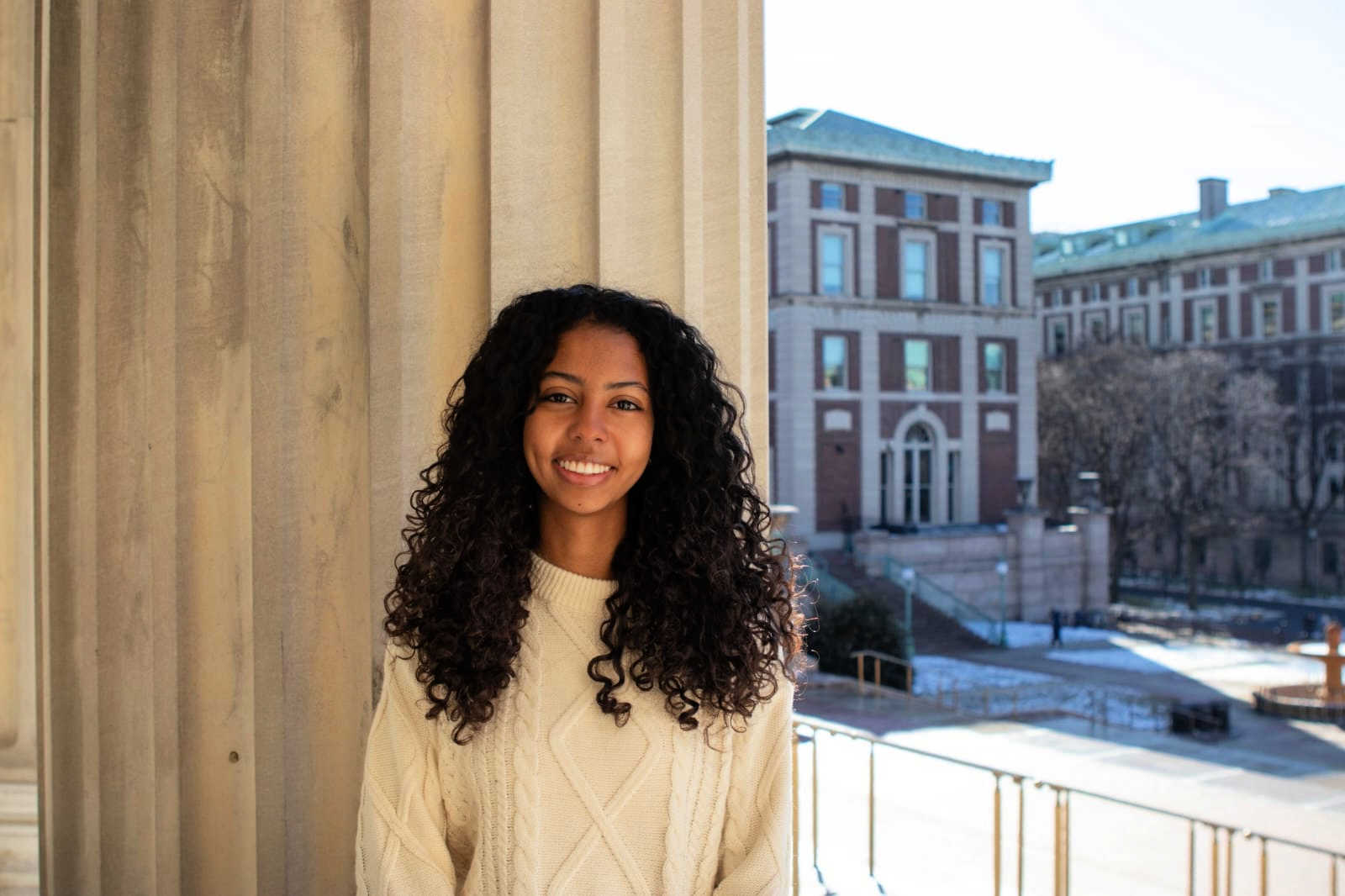
Tsehai Alfred, a St. Croix native and Editor in Chief and President of The Columbia Daily Spectator.
From a small, student-run newsroom on St. Croix to the leadership of one of the nation’s most influential college newspapers, Tsehai Alfred’s path in journalism has been defined by persistence, community focus, and a commitment to ethical reporting at a time when trust in media is under strain. Now appointed Editor in Chief and President of The Columbia Daily Spectator, Alfred reflects on the experiences that shaped her voice — beginning at home and carrying her to the center of national discourse.

Ms. Alfred’s first foray into the world of journalism was an ambitious one — restarting the Panther Post, the then-dormant newspaper of the Good Hope Country Day School. “I was operating with a team of maybe three reporters and was doing all the editing, layout, printing and a lot of the writing myself,” Ms. Alfred said.
That early ambition and determination would become a hallmark of the young journalist's career, which has taken her from the playground of GHCDS to the hallowed halls of Columbia University, where she was recently appointed Editor in Chief and President of The Columbia Daily Spectator.
In an exclusive interview with the Consortium, Ms. Alfred spoke about her development as a journalist and what it means in the current era, where information now more often than not is misused as a weapon rather than a means of enlightenment.
Her love for journalism was sparked during her time working on her high school paper. Writing profiles on community cultural icons, digging into a new school curriculum that was about to be implemented and discussing its potential ramifications, Ms. Alfred showed from early her interest and passion in the things that impact and intersect with the lives of her readers. “While that work was definitely not something I would put out today as I had no training or knowledge on the practice of journalism, I learned from that experience that I gain so much joy from speaking with people, sparking conversations in my community and uncovering information,” she said.
That joy she described was evident in her work for the Consortium. During the summer vacation of her freshman year at Columbia, where she is studying English, Ms. Alfred inquired about internship positions with the publication. Founder Ernice Gilbert, always eager to find and encourage new talent, readily agreed. From her first days, Ms. Alfred plunged eagerly into the hectic world of commercial journalism. Guided by Consortium Managing Editor Janeka Simon, Ms. Alfred hit the ground running, filing stories on community activism surrounding beach access, the public's ongoing frustration with local utility companies, and developments in high-profile criminal cases.
Tossed in at the deep end, Ms. Alfred demonstrated incredible grit and resolve when it came to “getting the story,” politely and persistently engaging with government officials and community leaders to demand answers on behalf of the public she served. Weeks into her internship, the junior reporter was instrumental in ensuring that business owners in Christiansted were not unduly fined for contravening a solid waste ordinance many did not know existed.
In her first articles on the issue in May 2024, Ms. Alfred uncovered the problem. That triggered a flurry of attention, prompting the St. Croix Administrator to step in and advocate for the cancellation of the charges. By mid-June 2024, the Waste Management Authority had agreed to temporarily halt the waste disposal fines while a public education campaign was conducted. The moratorium ended in August of that year, with business owners across the territory better informed of their obligations and responsibilities when it comes to the disposal of commercial waste.
“The opportunity to report on the community I grew up in and care so deeply about was personally very fulfilling,” Ms. Alfred said about her time with the Consortium. “More than anything the impact of the work stayed with me,” she continued, reflecting on the waste management reporting arc.
The ability to serve as a beacon of light for her community, to “uplift voices…that had been overlooked,” according to Tsehai, is a gift that she treasures. She has taken that same philosophy to Columbia. Her stellar work at the Consortium and at Spectator has now placed her at the helm of that publication, the second-oldest college daily newspaper in the United States, and the best student newspaper in the country according to the Society of Professional Journalists. As has become her habitual practice, Ms. Alfred has not shied away from engaging with controversial subjects. She spent weeks reporting as the Gaza Solidarity Encampment took hold on campus. “During that experience, I learned fast how to report on the ground, think fast and report with ethics and integrity,” she said. To some in the media industry, these concepts are mere buzzwords to inspire young journalists while realpolitik and backroom deals carry the day among industry overlords.
Ms. Alfred, however, insists that a return to bedrock principles is what journalism needs today. “Good journalism is more important now than ever because of erosions of democracy and growing distrust among audiences,” she declared. From her time with the Consortium, “I learned that local news and good journalism that aligns itself with community needs not only informs the community but, at its best, creates a shared sense of belonging that drives civic participation."

As the first black editor-in-chief of The Columbia Daily Spectator, Ms. Alfred understands this moment in history. The appointment “definitely holds a lot of weight but I am very grateful to take that work on,” she says. Despite the challenges that are sure to lie ahead, she is eager to continue her contributions to journalism and build on an already-excellent early career. “I am excited to leverage this non-profit identity to produce journalism and products that serve the public and build community,” Ms. Alfred concluded.


Advertisements