




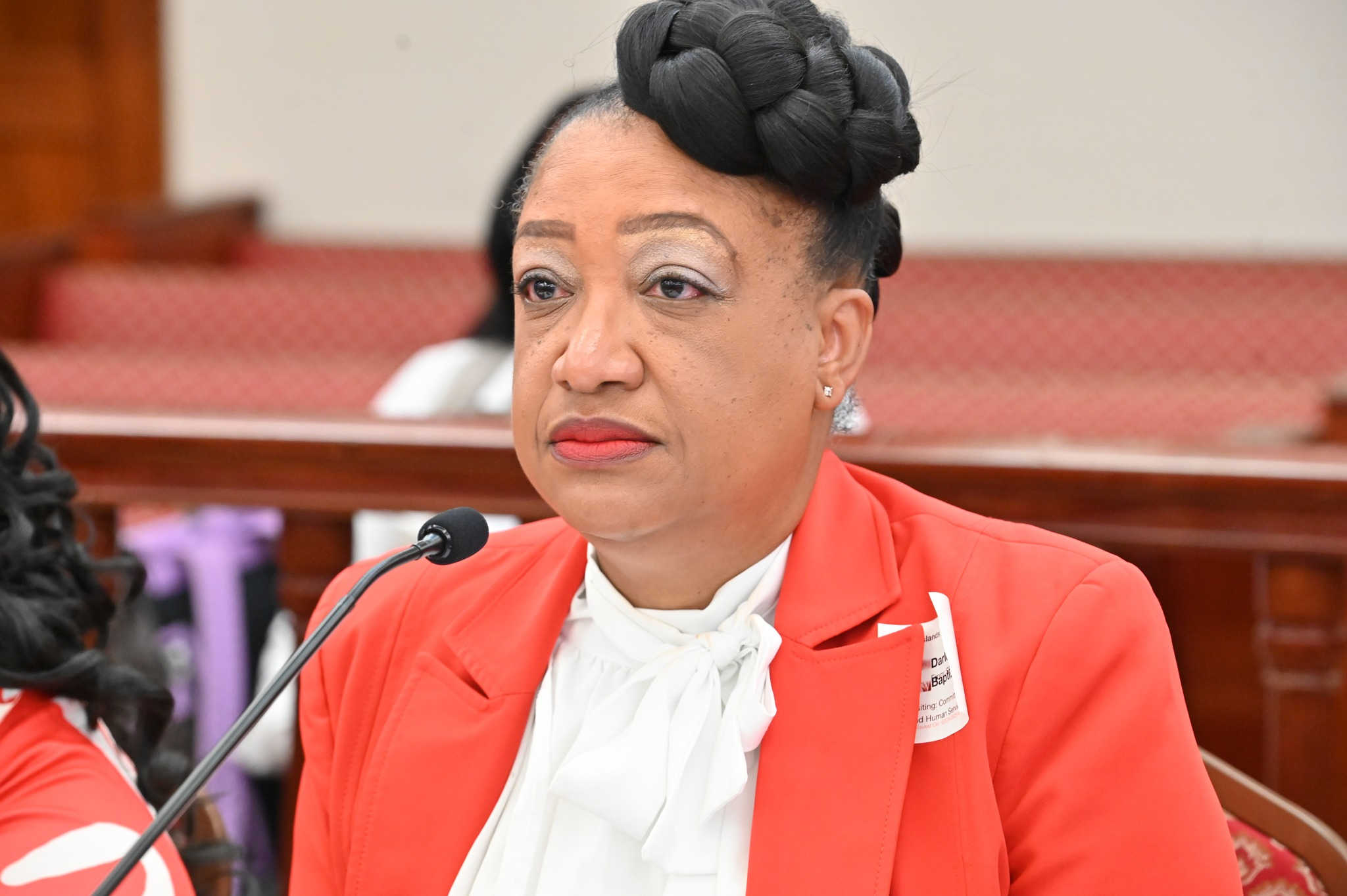
JFL & SRMC CEO Darlene Baptiste. Photo Credit: V.I. LEGISLATURE.
The integration of the territory’s two public hospitals is being presented as a path toward savings and stronger services, but the effort is unfolding against a backdrop of serious financial and operational strain. Lawmakers heard Tuesday that the Roy Lester Schneider Regional Medical Center and the Juan F. Luis Hospital continue to wrestle with billing failures, major vendor debt, supply chain problems, cash flow disruptions, and rising staffing costs, even as leaders push ahead with consolidation.

Those issues were at the center of testimony before the Committee on Health, Hospitals, and Human Services, where Darlene Baptiste — now serving as chief executive officer for both hospitals — appeared to provide an update on the integration process and the challenges facing the system. Before the unification, Ms. Baptiste led Juan F. Luis Hospital. The Government Hospitals and Health Facilities Corporation later named her chief executive officer over both hospitals as part of the integration effort.
The unification has been described as a way to cut costs, streamline procurement, and improve the services provided to the public. As part of that work, several administrative positions are being consolidated across the system. One person each is expected to fill the roles of chief operating officer, chief legal counsel, chief financial officer, chief human resources officer, chief quality officer, chief technology officer, and chief supply chain officer. Ms. Baptiste said the consolidation is expected to result in cost savings of $2 million, “with further savings expected as non-clinical management functions are consolidated.” She noted that the chief financial officer position has been identified as one of the most critical and is expected to be filled shortly.
Leadership is also working through broader system-wide changes. The CEO said she and her team are fully immersed in the integration process, with initiatives underway to strengthen both hospitals. That includes preparation of a draft handbook to be used across both territories.
At the same time, Ms. Baptiste told lawmakers that both facilities remain burdened by longstanding supply and financial challenges. “JFL and SRMC face ongoing supply chain challenges,” she said. Among the issues she cited were limited on-island inventory, vendor constraints, logistical delays, and “disruptions to cash flow.” She added that differences in product standardization and inventory practices between the hospitals have made those problems worse.
To address that, leadership is pursuing what Ms. Baptiste described as a “REBOOT framework,” which she said is intended to transform the supply chain and help it “withstand disruptions including cash flow constraints.” She said staff and patients should expect “streamlined sourcing, inventory management, and distribution reduce waste and cost.”
Cash flow remains a central problem for both hospitals. Ms. Baptiste said the integration effort is also moving toward “a more coordinated approach to key financial functions, including billing and collections.” A “Revenue Cycle Improvement Project” is being led by FirstSource and is meant to strengthen billing and collection processes.
At Schneider, that system was rolled out in September 2025 and has already been “critical in identifying where breakdowns occur,” Ms. Baptiste said. She also told lawmakers that SRMC will launch a “comprehensive self-pay strategy in May” in an effort to improve collections. According to the testimony, collections at SRMC have increased by 35% over the same period last year and now total approximately $4 million to $4.5 million a month.
Even so, better collections have not erased SRMC’s larger financial problems. The hospital owes various vendors $49 million. It is also carrying the cost of 17 boarders, which amounts to $450,000 a month in unfunded care. Temporary staffing, which is being used to fill human resource gaps at SRMC, costs $1.4 million a month. At the same time, various government entities owe SRMC “approximately $1.7 million.”
Juan F. Luis Hospital is facing many of the same pressures. Ms. Baptiste said cyber attacks had left the hospital unable to bill for a period of time, and testified that the work with FirstSource is helping JFL make “steady progress toward stabilization.” According to the CEO, “focused efforts are ongoing to recover claims backlogs.”
JFL’s financial stress extends beyond billing. Ms. Baptiste acknowledged that “liquidity constraints” have affected the hospital’s ability to stay current on GERS and income tax payments for employees. She said “cash flow limitations and the prioritization of payroll and critical supplies” have delayed some payments.
Like Schneider, JFL is also carrying major vendor obligations. The hospital owes vendors approximately $22.5 million. In fiscal year 2026 alone, JFL has accumulated $1.5 million in locum coverage and “associated accommodation costs.” Government entities owe JFL $5.7 million. Ms. Baptiste said an available line of credit at JFL will be used to “address obligations to critical vendors, and support continued operations.”
Lawmakers listening to the update expressed frustration, particularly over the failures in billing. Senator Kurt Vialet said the Legislature has repeatedly appropriated money while the hospitals have continued to miss revenue opportunities because of billing breakdowns.
“This institution literally tired of appropriating funds and the hospital not billing,” Senator Vialet bemoaned.
He also questioned whether staff in billing positions understood what was at stake when claims were not processed.
“I really wonder if they're not understanding that every single time they don't bill, that we can't procure supplies,” he said.
Senator Alma Francis Heyliger, focusing on the financial outlook, asked for a “potential solvency date” now that billing assessments have been carried out. Kenisha Angol, SRMC’s director of finance, responded that the required process changes “is going to take some time. It's not going to happen overnight.” She said the timeline could be about two years, based on “substantial changes around revenue and expenses.”
Supply issues also remained a point of concern for lawmakers. Senator Vialet said there is “no way that is allowable or acceptable that we have to run out of any type of medication or any of the basic supplies necessary for day-to-day operation.” Senator Clifford Joseph argued for a territory-wide system that could anticipate shortages and respond before supplies run low.
LeRue Browne, SRMC’s director of procurement and materials, told lawmakers that the team “will be on top of supply chain for both facilities.”
The hearing made clear that the integration is about much more than combining leadership titles. One chief executive officer is now responsible for two hospitals with separate operational pressures, separate financial burdens, and overlapping structural problems. For Ms. Baptiste and the unified team she is assembling, the task now is to turn consolidation into measurable improvement while stabilizing billing, restoring vendor confidence, improving supply reliability, and strengthening care for Virgin Islanders.



Advertisements


