



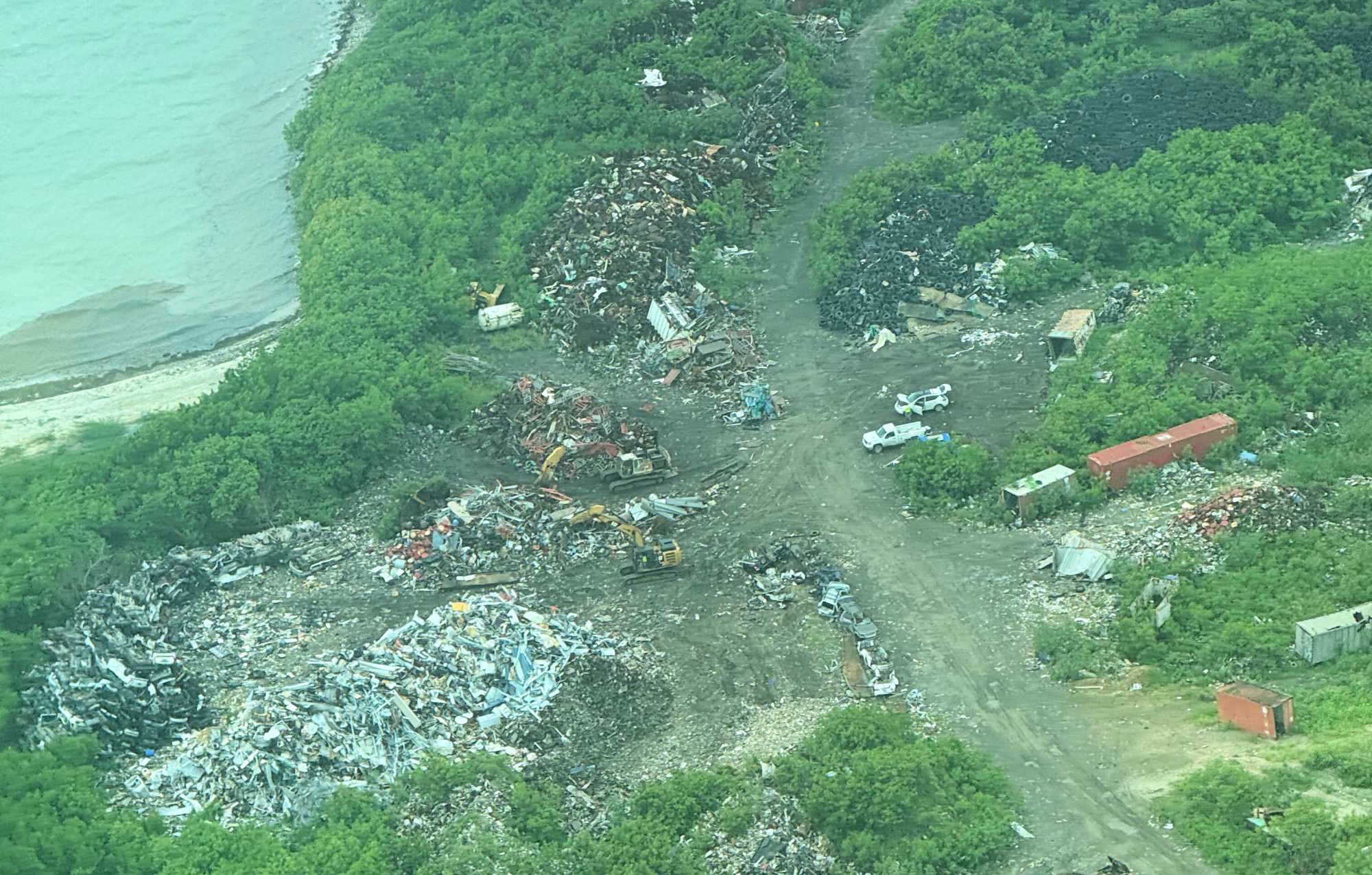
A portion of the St. Croix Anguilla Landfill. Photo Credit: V.I. CONSORTIUM.
At a public hearing Thursday evening, Waste Management Authority officials and the University of the Virgin Islands’ Caribbean Green Technology Center laid out the scope of what they say is a long-overdue transformation of the territory’s waste system, one that would require new laws, new fees, modernized dump sites, better handling of specialty waste streams, and a phased strategy for tackling urgent problems such as green waste, illegal dumping, and aging infrastructure.

While officials said a territory-wide sustainable materials management plan is taking shape and pointed to several recent steps already underway, many in attendance focused on when the proposed changes will actually begin.
The V.I. Waste Management Authority, together with UVI’s Caribbean Green Technology Center, convened the hearing to discuss development of a territory-wide waste management plan.
According to WMA Executive Director Hannibal Ware, the Authority is currently struggling to manage a “modern waste challenge with an outdated system.” He said the agency continues to face several major problems, chief among them chronic underinvestment dating back to its inception. As a result, WMA is burdened by high debt and an inability to properly maintain aging infrastructure.
Greg Guannel, director of the Caribbean Green Technology Center, said the answer is an “integrated sustainable material management plan.” A central part of that plan, he said, is revenue generation through direct fees charged to residents as well as the processing of waste into products WMA can sell.
“We have one of the lowest tipping fees in the whole of the United States,” Mr. Guannel noted. Even so, he said, the territory continues to face widespread illegal dumping. Dump sites also need modernization, but WMA’s lack of funds is slowing that progress.
Mr. Guannel said the legal framework governing waste is also outdated. “The laws were created 50 years ago, more or less,” he said. He noted that there is no clear statute assigning responsibility for medical waste or other hazardous materials.
“There is a lack of a management framework for cars,” he added. While many residents believe WMA is responsible for derelict vehicles, he said the law places that responsibility with police. He also argued that bulky consumer waste such as washing machines and refrigerators is not properly regulated.
He further pointed to organic waste from restaurants and bars, large volumes of glass waste generated by the tourism industry, and the growing problem of e-waste, for which there are no consumer disposal regulations. Sargassum is also an issue, he said, because heavy metals in the material prevent it from being used as compost. Disposing of it requires shipping it out of the territory, which adds cost.
“Let’s address the law, create clear rules, responsibility, financing for all of this, so that we can move on and be very clear,” he urged. He said the territory should start anticipating future waste issues now and create laws to match, while also giving WMA the financial and human capacity to handle its increasingly complex waste stream.
Mr. Guannel also recommended considering a new structure for WMA, one that would operate more like WAPA and have greater control over its operations. Under that model, he said, the entity could still receive central government funding but would not have to continually seek additional support. He said the overall plan will depend on incremental change and consistent communication with the public.
Despite the challenges, Mr. Ware said WMA has made “significant strides” since he became executive director. He pointed to repairs to the scales on St. Croix, with work on St. Thomas and St. John expected to be completed shortly, as one example. That work, he said, will move the territory toward a weight-based fee system for residential trash collection.
“I just wanted to point that out, so that folks understand that we’ve been in conversations, and we are moving in the right direction,” Mr. Ware said.
Because many of the modernization strategies have already been discussed in previous public meetings, attendees on Thursday were mainly interested in implementation timelines.
WMA officials disclosed that a territory-wide waste separation effort will launch in the coming days through a public-private partnership with Replastic VI. “The communication about this will be unveiled shortly, where we’re going to start the education campaign to deal with separating plastics at first,” said Mr. Ware.
At least two attendees raised questions about whether composting green waste should be prioritized over introducing incinerators. However, officials said the territory needs a faster solution to the volume of green waste already on hand.
“We have, I think, 1.5 million cubic yards of green waste in our landfills. We get in about…70 tons of green waste into the landfills on a daily basis,” Mr. Ware disclosed. “We have a crisis with our green waste in the territory currently. Air curtain incineration could reduce the issue that we have by 90% almost, whereas composting is more of a long range solution.”
Mr. Ware said composting remains an important part of the sustainable materials management plan, but argued that a faster method is needed first to reduce the backlog. Once the immediate crisis is brought under control, he said, other green waste management methods could be introduced.
The hearing also touched on the possibility of waste-to-energy systems that could help reduce power costs for consumers. Mr. Ware said that is part of his “long-term vision” for WMA, but described it as “extremely complicated” and “technical.” Although vendors have shown strong interest, he said, WMA would first need to develop an appropriate request for proposals. “We are simply not there yet,” Mr. Ware admitted.
Mr. Guannel said he was not convinced that a waste-to-energy project would significantly affect energy bills in the territory. “WAPA bill is a structural issue linked to the debt that WAPA has,” he argued. He said a new study would likely be needed to assess the viability of such a project because the waste stream has changed since previous research was done about 15 years ago.
The waste management plan now under consideration, Mr. Guannel said, would include a general fee for garbage collection, along with additional point-of-purchase fees for bulky goods, e-waste, and other specialty waste items.
Officials said the full plan will soon be released for public review and comment.



Advertisements


