
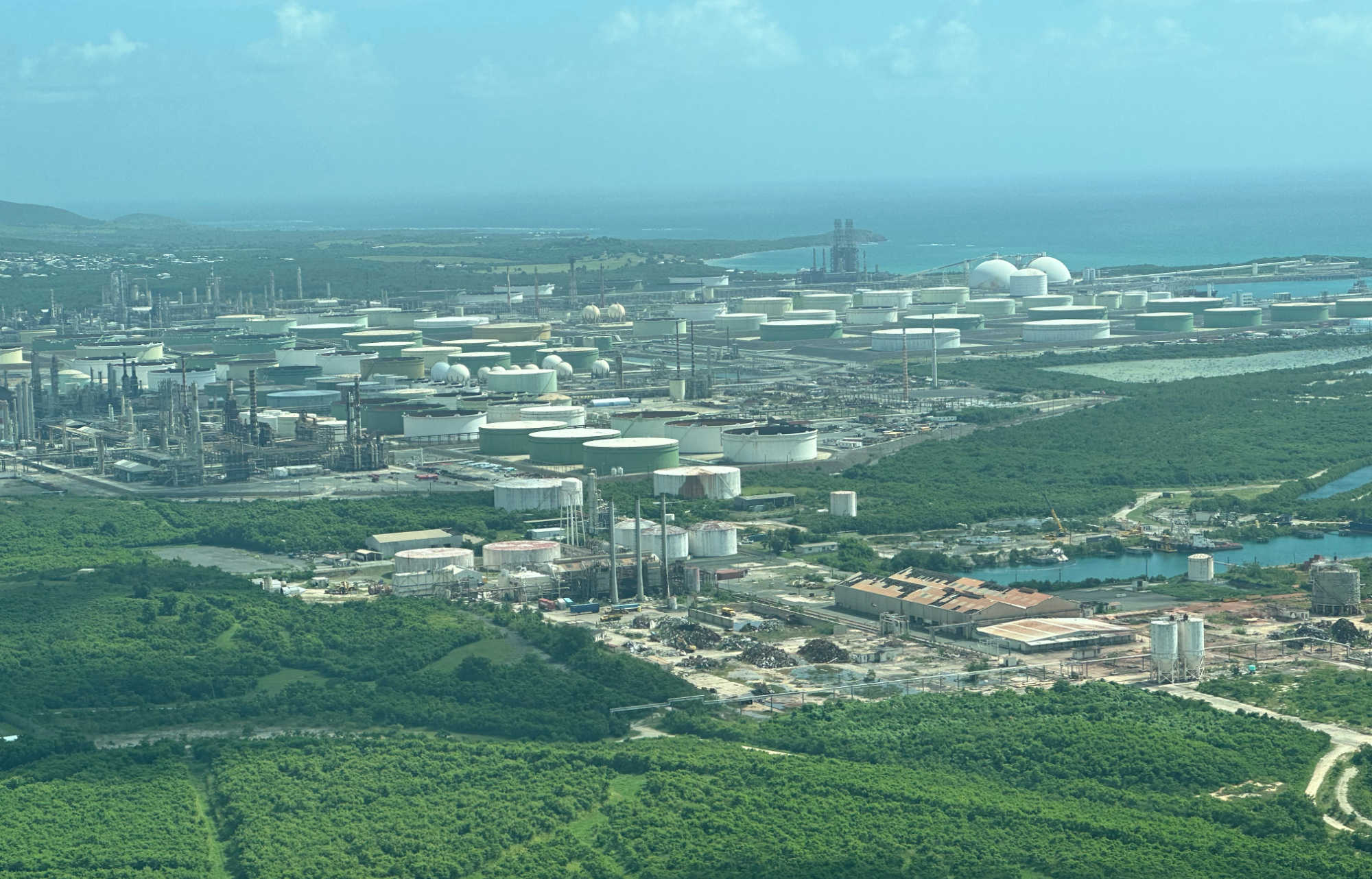
The St. Croix oil refinery located on the island's south shore, now owned by Port Hamilton Refining and Transportation. Photo Credit: V.I. CONSORTIUM.
The U.S. Environmental Protection Agency has approved an amended workplan from Port Hamilton Refining and Transportation LLLP, clearing the way for the continued removal of hazardous materials at the St. Croix refinery under a binding legal agreement reached in 2024.

EPA confirmed that it approved the amended workplan on December 23, 2025. The plan, submitted by Port Hamilton, outlines additional steps to remove hazardous materials from the refinery site, a process required under a 2024 Administrative Order on Consent addressing compliance with the Clean Air Act.
Under the amended workplan, Port Hamilton is removing liquefied petroleum gas, or LPG, from two units at the facility, identified as LPG Units 1 and 2. The LPG is being transferred into ISO containers for shipment off island. To manage remaining vapors within the units, Port Hamilton is using a thermal oxidizer, a pollution control device designed to destroy harmful industrial emissions.
Port Hamilton and its contractors resumed hazardous material removal activities on January 12, 2026, following preparatory steps taken by the EPA. The agency began setting up its air monitoring network at the refinery on January 8, 2026, ahead of the restart of removal operations outlined in the amended workplan. EPA anticipates that the LPG removal work will be completed in early February.
The current work builds on actions already taken under the 2024 agreement. In August 2024, EPA and Port Hamilton entered into the Administrative Order on Consent to establish specific requirements for safely removing hazardous materials from the refinery. Those requirements include inspections, monitoring, and targeted actions related to the refinery’s LPG units.
Between August 29 and October 24, 2025, Port Hamilton removed and destroyed approximately 23,510 gallons of materials, including LPG, from a temporary storage container and from LPG Unit 1. Those actions were carried out as part of the obligations set forth in the 2024 legal agreement.
Air quality monitoring remains a central component of the ongoing work. EPA Region 2, together with its Superfund Technical Assessment & Response Team (START) contractor, is conducting continuous air monitoring at fixed stations within the refinery during removal operations. In addition, EPA and its contractors are performing daily air quality assessments using portable monitoring equipment at various locations across the site.
The portable devices are capable of detecting mercury vapor, hydrogen sulfide (H₂S) gas, and volatile organic compounds (VOCs). Mercury vapor is invisible and odorless but can pose serious health risks through inhalation. Hydrogen sulfide is a colorless gas known for its “rotten egg” smell and can be highly toxic at elevated concentrations.
EPA said the monitoring equipment provides real-time data, alerting personnel to potentially dangerous conditions. The monitors are used to ensure air quality levels remain below established safety thresholds, helping protect workers at the facility and residents in surrounding communities from potential exposure. The equipment also tracks oxygen levels and can detect the presence of explosive gases.

EPA said monitoring will continue throughout the hazardous material removal process as Port Hamilton carries out the remaining requirements of the 2024 agreement.


Advertisements