

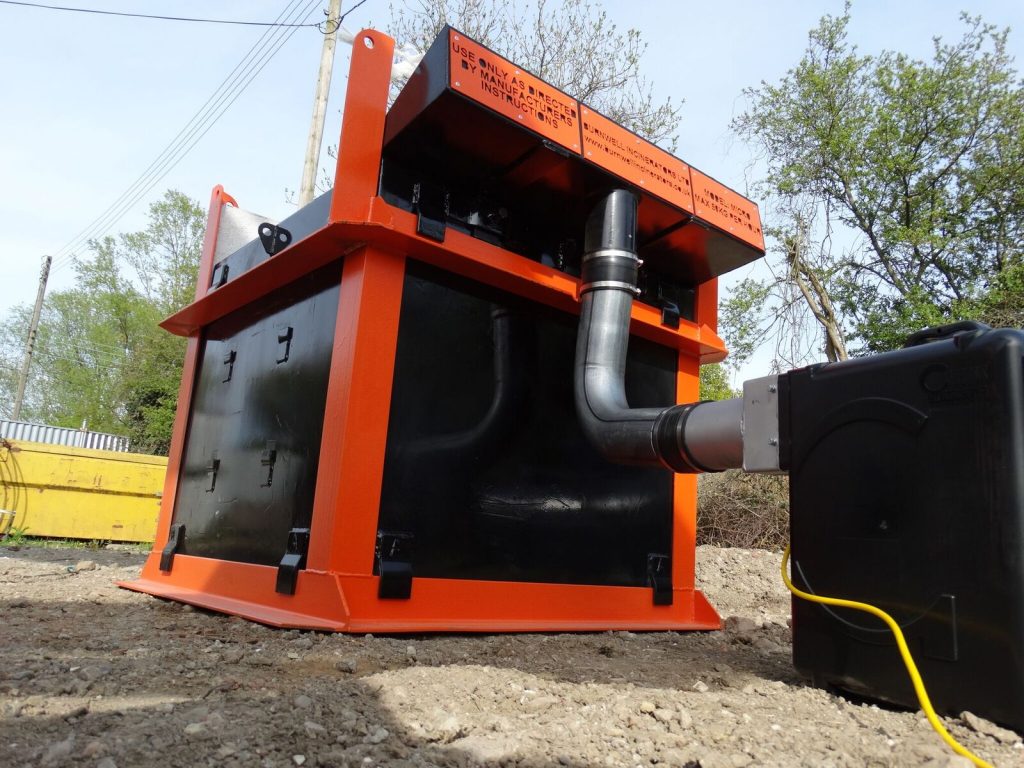
An amended version of Bill 36-0232 garnered just enough support to be forwarded to the Committee on Rules and Judiciary after its second hearing in the Committee on Government Operations, Veterans Affairs and Consumer Protection on Monday.

Sponsored by Senator Clifford Joseph, the bill authorizes the use of air curtain incinerators as a method of dealing with massive piles of green waste in the territory’s two landfills. The law, as currently written, bans the burning of green waste. Since being introduced two weeks ago, the bill has been held in committee, special-ordered to a Legislative Session, and subsequently returned to its committee of jurisdiction.
During Monday's committee meeting, Senator Novelle Francis included an amendment that requires the Waste Management Authority to comply with several conditions, including a requirement that the air curtain incinerator’s operator be certified by the manufacturer. The machine must also not be operated “within 300 feet of any residence,” and before commencing operations, WMA must obtain certification from DPNR.
Additionally, “the incinerator shall not be operated unless there are at least four air quality monitors located at the perimeter of the incinerator site” and the collected data “shall be made publicly available to the Virgin Islands Waste Management Authority monthly, in a manner accessible to the public.”
If the data shows that air quality is affected, the use of the incinerator “shall cease for not less than 24 hours, or until compliance is achieved.” The amendment also requires that the machine be inspected at least twice a year.
Sen. Francis’s amendment followed even more discussion on the bill and was an attempt to create a happy medium between opposing sides. Ultimately, four of the seven present senators voted in favor of the amended bill. Senator Ray Fonseca, who himself had an amendment to the bill prepared, voted against it. Senator Carla Joseph chose not to vote and intends to introduce another amendment. Senator Alma Francis Heyliger also chose not to vote until she had reviewed all of the proposed amendments to the bill.
Monday’s amendment and the subsequent vote followed additional testimony on the measure. Representatives of the Departments of Health, Planning and Natural Resources, and community members were invited to testify this go around.
DPNR Commissioner Jean Pierre Oriol, a proponent of the bill, cited several benefits including reduced risk of landfill fires by reducing the amount of green waste stored there. A significant portion of his testimony focused on a preference for the air curtain incinerators over other transformative measures like mulching, chipping, and composting. Stating that he was in favor of those solutions, Mr. Oriol insisted that they are not “our solution, as there is an issue of volume.”
“We simply do not have the customer volume for mulching and chipping alone, and any unused material, after a time, will be taken to the landfill,” he said. Mr. Oriol told lawmakers that the customer base among farmers, hotels, and other interested parties was not sufficient. Without a market, there could be “stockpiles of material” that could lead to more landfill fires. For Mr. Oriol, the biochar generated by air curtain burning was a better solution and is still useful to farmers.
Noting concerns with several of the disposal methods, the Department of Health took no official position on the bill. Instead, Assistant Commissioner Ruben Malloy recommended that “any selected approach include strict operational controls and monitoring.”
For community member Felicia Blyden, the original version of the bill was “vague” and though it mentioned methods like mulching, there was “no commitment to utilizing these technologies to address the green waste issue.”
She feared potential air quality issues could impact the thousands of people living in proximity to the Bovoni Landfill on St. Thomas. Ms. Blyden recommended that the bill “focus on composting, mulching and shredding” as she considered them “sustainable activities with the least impacts on human health and the environment.”
The committee also received testimony from Dawn Henry, the chief executive officer of the V.I. Environmental Association. Ms. Henry, too, worried about the impact on air quality, reminding lawmakers that opacity readings associated with air curtain incinerators identify visible smoke rather than the “presence or absence of toxic pollutants during combustion.”
She advised that “emissions must be acknowledged and considered in any deliberation about whether ACI is the most appropriate option for managing vegetative debris in the territory.”
Like testifiers before her, she appealed for a mixed methods approach to handling green waste, and warned that the bill would eliminate the stock required for composting, chipping and mulching, and “remove incentives to invest in higher order waste management practices.”
WMA also testified once more on Monday. Chief Financial Officer Daryl Griffith maintained that the incinerators are not a “luxury” but a “necessary preventive tool that addresses a documented and growing risk.” He assured that the authority would continue shredding and mulching, and intends on using some $6 million in grant funding for equipment purchases.
Comments from lawmakers remained largely the same. Some like Senators Alma Francis Heyliger and Carla Joseph, shared similar environmental and public health concerns as the residents of Bovoni. Senator Milton Potter stressed the need to consider the public’s perspective and agreed that it should be used in conjunction with other methods. Mr. Griffith agreed that “burning should not be our first option.”
Senator Ray Fonseca, at times, seemed to vehemently oppose the bill, but at other times, proposed amendments, including limiting the use of the incinerators to St. Croix only.
When questioned, testifiers like Dawn Henry lamented the absence of territorial composting initiatives, something the Waste Management Authority’s chief financial officer blamed on a lack of funding.
Senator Avery Lewis, meanwhile, noted that without action, stakeholders would continue “kicking the can down the road.”
The V.I. Fire and Emergency Management Services was also on hand, with Deputy Chief on St. John Magabe Calixte telling lawmakers that “talking ain't getting nothing done. We need action…We don't have time to be debating back and forth as to what needs to be done. We need to do something.”
St. Thomas/St. John Fire Chief Eustace Grant joined Mr. Calixte in reminding listeners of the difficulty associated with fighting landfill fires, often ignited by green waste. “I believe in this air curtain because if we don't move on it, we going to stay with a problem,” he stated.

Senator Kenneth Gittens would eventually move to advance the bill, having stated earlier that the community was “rightfully worried,” but “we must come up with solutions.” More amendments are expected.


Advertisements