

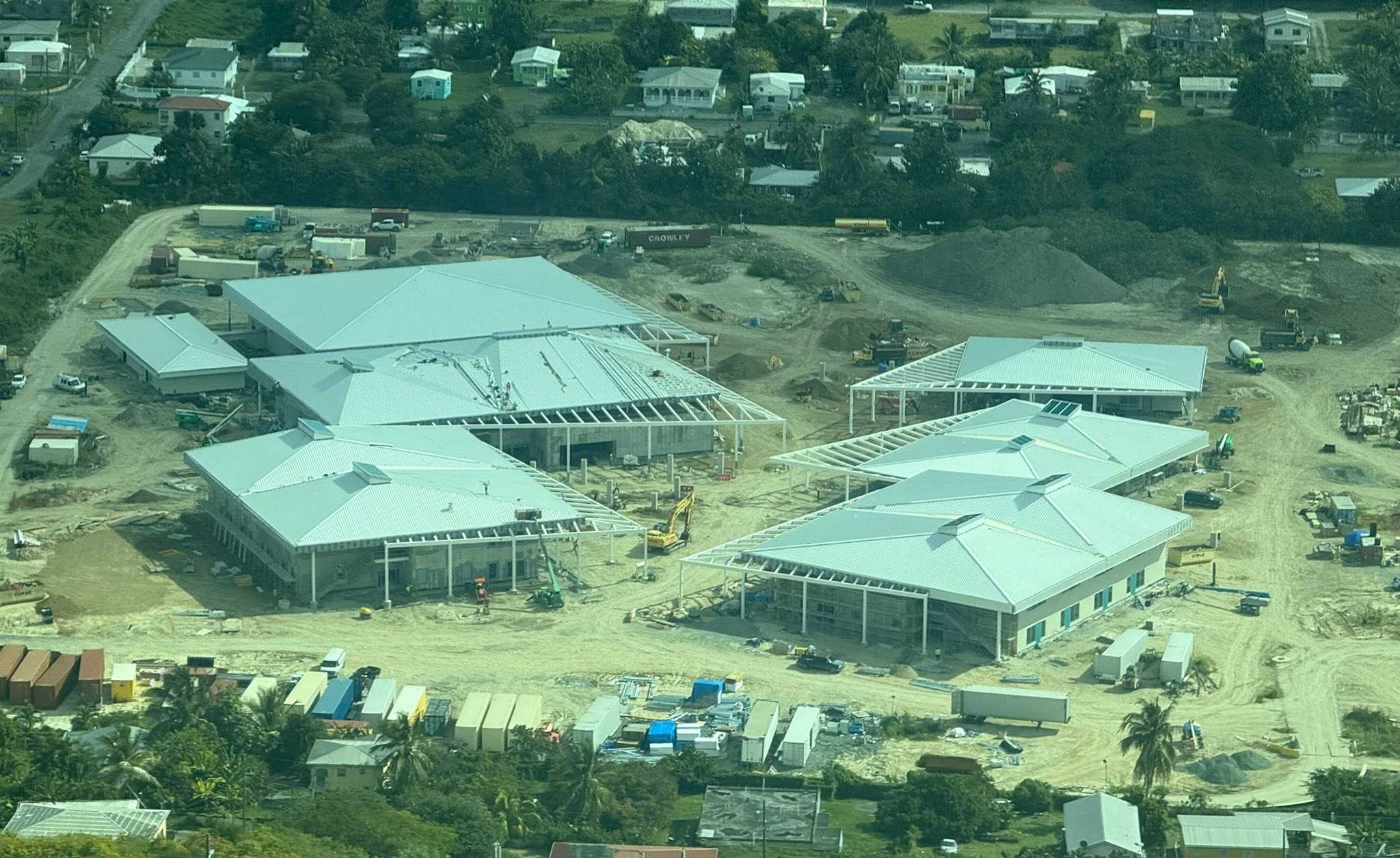
The Arthur A. Richards K-8 School is scheduled for a grand opening in June 2026 — in time for the new school year. Photo Credit: ERNICE GILBERT, V.I. CONSORTIUM.
The V.I. Department of Education is preparing to undertake what officials describe as the most comprehensive redistricting effort on St. Croix in roughly 30 years, a sweeping reorganization driven by enrollment imbalances, population shifts, school capacity concerns, and rising operational costs.

The plan could affect more than 200 students who currently attend schools outside of their assigned educational district, as lawmakers and education officials weigh how best to realign school populations while accounting for family circumstances, staffing realities, and campus readiness.
Presenting before the Committee on Education and Workforce Development, Education Commissioner Dionne Wells-Hedrington described the initiative as a “data-driven response to longstanding enrollment imbalances, shifting population patterns, aging infrastructure, and increasing operational costs.”
According to VIDE officials, 213 students on St. Croix are currently attending schools outside of their educational district. The department says the closure of housing communities in Christiansted, followed by the relocation of many families to Frederiksted, has “resulted in a major population shift to the western end of the island” and distorted school composition.
If no action is taken, Wells-Hedrington warned, the territory “will continue to face overcrowded classrooms in some areas, underutilized facilities in others, and escalating transportation costs.”
As a result, parents of more than 200 students could soon receive correspondence from VIDE regarding their child’s new school placement for the upcoming academic year. High school students are currently exempt from the exercise.
The reorganization of the St. Croix district comes as the Arthur A. Richards K-8 School prepares to reopen, while VIDE is also making what officials described as the “tough decision” to close the John H. Woodson Junior High School, despite millions having been spent on remediation work there. Students who currently attend Woodson, as well as those who had planned to attend, will instead be housed at one of the district’s other K-8 schools.
At the center of the redistricting effort is the principle that “students shall attend school based on the residential boundary lines that feed into the various schools.” Although VIDE presented the revised boundaries to lawmakers, Senator Marise James recommended the use of an interactive, color-coded map so the changes can be more easily understood.
The V.I. Board of Education told lawmakers it was not involved in the development of the redistricting plan. Board Chair Dr. Kyza Callwood encouraged VIDE to establish a “centralized, high-touch Redistricting Support Call Center” to serve as a primary point of contact for families.
Public awareness is expected to be a major component of the process. VIDE says it plans to roll out a “comprehensive communication plan using both print and audio messaging” to keep families informed. An in-person meeting for seventh-grade students of the John H. Woodson Junior High School is scheduled for April.
Notification of school placements is expected between April and May. Wells-Hedrington is asking parents to wait for official confirmation before purchasing uniforms. Parents are also being urged to update their addresses with VIDE, as address records will determine school placement. Acceptable documentation includes leases, mortgages, or utility bills.
Lawmakers generally agreed that redistricting is necessary, but noted that there are several reasons why students may be attending schools far from home. Senator Kenneth Gittens reminded VIDE that many families have moved to Frederiksted on a temporary basis while housing units in Christiansted undergo rehabilitation.
“We have to be careful of just stopping them from going to the school…they might be right back to their residence,” Senator Franklin Johnson warned.
Wells-Hedrington said that “requests for special consideration will be reviewed on a case-by-case basis.”
Superintendent Carla Bastien-Knight pointed to employees as one example of the kinds of cases that may require flexibility. “We're going to look at our employees who live in Frederiksted, but work at Pearl B. Larson. We don't expect you to drop your child to Claude O. Markoe and then rush come all the way up to Pearl B. Larson,” she said.
Senator Kurt Vialet said officials should prepare for significant pushback from affected families. “You have a difficult task ahead because you have 213 out of district. You're going to get 213 justification,” he said. “It's just a difficult conversation,” Vialet added, while underscoring the importance of rightsizing school populations and managing both human and physical resources.
Beyond student placements, lawmakers were told that several operational issues must also be addressed as VIDE moves forward with the plan.
The Bureau of School Construction and Maintenance is expected to play a key role, particularly with the new Arthur A. Richards School on the site of the former Evelyn Williams Elementary School, set to open in June 2026. BCSM Executive Director Craig Benjamin told the committee that the Bureau needs to “expand its workforce to ensure it can effectively maintain” the school while continuing to meet the needs of other campuses.
Benjamin said the presence of a swimming pool at Arthur A. Richards adds to the need for additional staff and resources. He also told lawmakers that the Bureau’s budget should be “increased to at least $5 million, in accordance with Act 8717."



Advertisements