
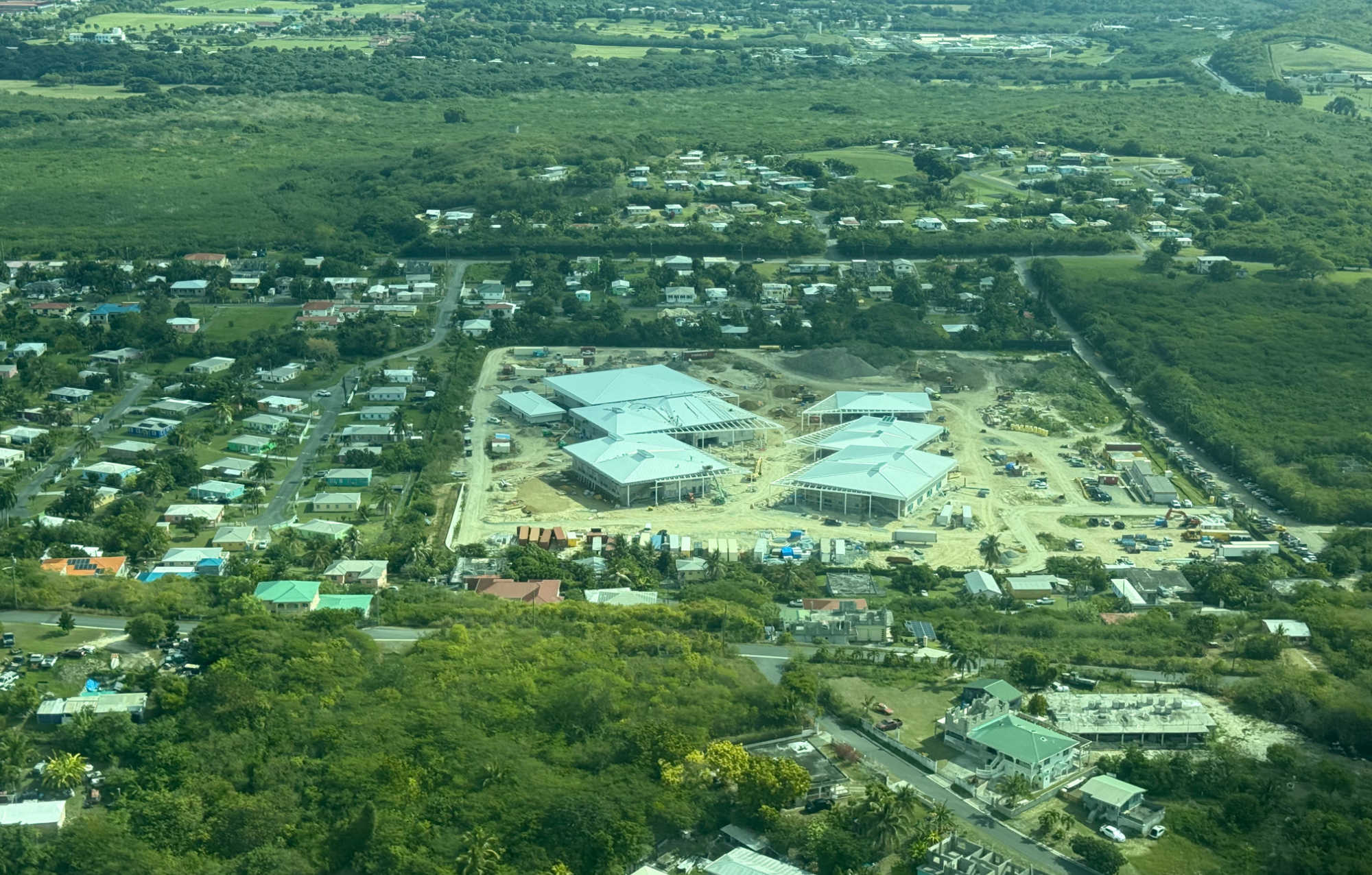
The Arthur A. Richards K-8 School under construction by MCN Build. Photo Credit: V.I. CONSORTIUM.
With the Virgin Islands advancing through a federally funded recovery effort marked by tight deadlines and complex tradeoffs, Governor Albert Bryan Jr. says the pace of rebuilding is “right where it needs to be,” even as questions persist about priorities, labor, and the economic consequences of rapid construction.

Speaking during a wide-ranging and at times disjointed discussion on WTJX’s Analyze This, the governor addressed how recovery projects are being sequenced and why restraint, in his view, is as important as speed. Billions of federal dollars are in play and matching-fund timelines have to be met. Mr. Bryan said the challenge lies not only in building quickly, but in choosing what to build first without destabilizing the local economy.
That balancing act, he suggested, requires difficult decisions. Among the most urgent needs, Bryan pointed to hospital infrastructure, describing the Juan F. Luis Hospital on St. Croix as “falling down.”
“The St. Thomas hospital is a priority, but St. Croix hospital is an emergency. We need to get a hospital done,” he said.
The governor indicated that not all projects carry the same urgency. While students are expected to soon enter the new Arthur A. Richards K–8 School, he said other school reconstructions must be weighed individually. The rebuilding of Ivanna Eudora Kean High School, for example, “could wait,” he said.
Bryan argued that failing to sequence projects carefully could have serious economic consequences.
“What you're doing is you're putting all this money on the street. You're just creating tremendous inflation,” he said. “You're bringing in people, you're driving up the rent.”
If construction activity is not managed properly, Bryan warned, costs could spiral far beyond reasonable levels, reaching “$800 a square foot, where it should cost $125.” He expressed frustration that, in his view, “people don't understand economics in that level.” Program host and former Senator Neville James suggested that a more basic explanation of these dynamics might help the public better grasp the governor’s concerns.
The conversation later turned to workforce issues, an area that has become increasingly central as recovery projects move toward execution. Bryan responded to recent remarks from Delegate to Congress Stacey Plaskett, who told The Consortium following the State of the Territory Address that low unemployment figures mask a pool of disengaged Virgin Islanders who could be drawn back into the labor force through targeted training and upskilling.
Those comments, Bryan said, “surprised” him.
“I invite the Delegate to go down to look for these people who she talking about, who, ‘oh, they're not participating’,” he said. According to the governor, those who are not working simply “don't want to.”
While Plaskett suggested incentives and training could encourage reentry into the workforce, Bryan said the scale of the recovery demands a different approach. “We need people to work. We need to have foreign labor,” he said, estimating that roughly 5,000 skilled workers will be needed to carry out the recovery.
He also pointed to the aging profile of the existing construction workforce. “Old people,” Bryan said, before adding, “I consider myself an old person to be outside pushing a wheelbarrow,” referring to himself at age 57.
Expanding access to foreign labor, however, comes with its own complications. Bryan noted that decisions made decades ago continue to shape current options. He recalled community objections to migrant workers “coming and taking the jobs,” which ultimately led Congress to restrict H1B visas in the territory to entertainment and sports personnel.
Despite increasingly restrictive immigration policies at the federal level, Bryan said he is still exploring ways to revisit and potentially expand those visa limitations to meet the demands of the recovery effort.
Taken together, the governor’s remarks painted a picture of a recovery he believes is proceeding at the right speed, but one constrained by economic realities, workforce shortages, and policy decisions—past and present—that continue to shape how and when the territory rebuilds.



Advertisements