

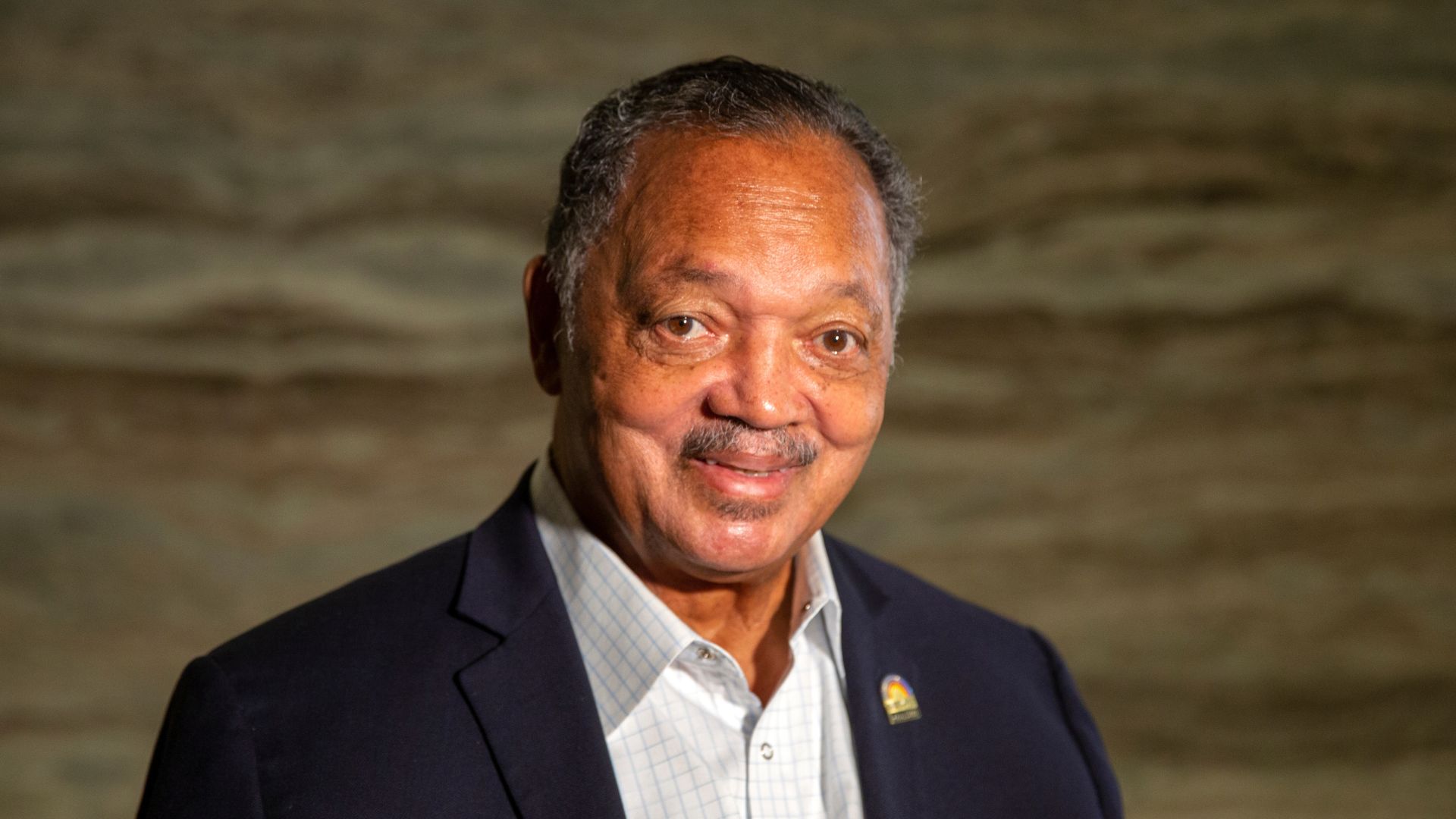
The Rev. Jesse Jackson.
The Rev. Jesse Jackson, a central figure in the American civil rights movement who twice sought the presidency and spent more than six decades advocating for racial and economic justice, died early Tuesday at the age of 84, his family announced.

In a statement, his family said he passed peacefully surrounded by loved ones. No immediate cause of death was provided. Jackson had been living with Parkinson's disease since 2017, a condition that had increasingly limited his public appearances in recent years.
Born on October 8, 1941, in Greenville, South Carolina, Jackson rose from modest beginnings to become one of the most influential Black leaders in U.S. history. He initially attended the University of Illinois on a football scholarship before transferring to North Carolina A&T, where he became active in the civil rights movement. Ordained as a Baptist minister in 1968, Jackson worked closely with Dr. Martin Luther King Jr. and served as a key aide during the 1960s. He was present in Memphis in 1968 when King was assassinated.
In 1984, Jackson founded the Rainbow Coalition, an organization aimed at uniting diverse constituencies—including minorities, women, and the working poor—in pursuit of progressive policy goals. That same year, he launched his first campaign for the Democratic presidential nomination. He became the first Black candidate to win multiple primaries, earning significant national support. Jackson ran again in 1988, finishing second to Michael Dukakis, further cementing his role as a bridge between civil rights activism and mainstream politics.
Throughout his career, Jackson became known for his forceful oratory and international advocacy. He negotiated the release of American hostages in Syria, Cuba, and Iraq. He marched against apartheid in South Africa and supported economic boycotts aimed at influencing corporate hiring practices. Within the United States, he led voter registration efforts that registered millions and advocated for affordable housing and education reform.
His public life was marked by both achievement and controversy. Jackson faced criticism over past antisemitic remarks, including a 1984 reference to New York City as "Hymietown," for which he later apologized. In 2001, he acknowledged an extramarital affair that resulted in a child. Despite those episodes, he continued to serve as a prominent voice on issues such as police brutality and income inequality and mentored emerging political leaders, including Barack Obama.
Tributes were issued across the political spectrum following news of his death. President Joe Biden described Jackson as "a giant who changed America for the better." Former President Barack Obama called him "a bridge to the future." Civil rights leader Rev. Al Sharpton said Jackson was a mentor who "opened doors for all of us."
Jackson is survived by his wife, Jacqueline, whom he married in 1962, and their five children, including Congressman Jesse Jackson Jr. The family has not yet announced funeral arrangements and requested privacy.
Throughout his life, Jackson frequently invoked a phrase that became synonymous with his activism: "Keep hope alive." In the wake of his death, that message continues to echo as part of his enduring legacy in the fight for civil rights and social justice.



Advertisements