

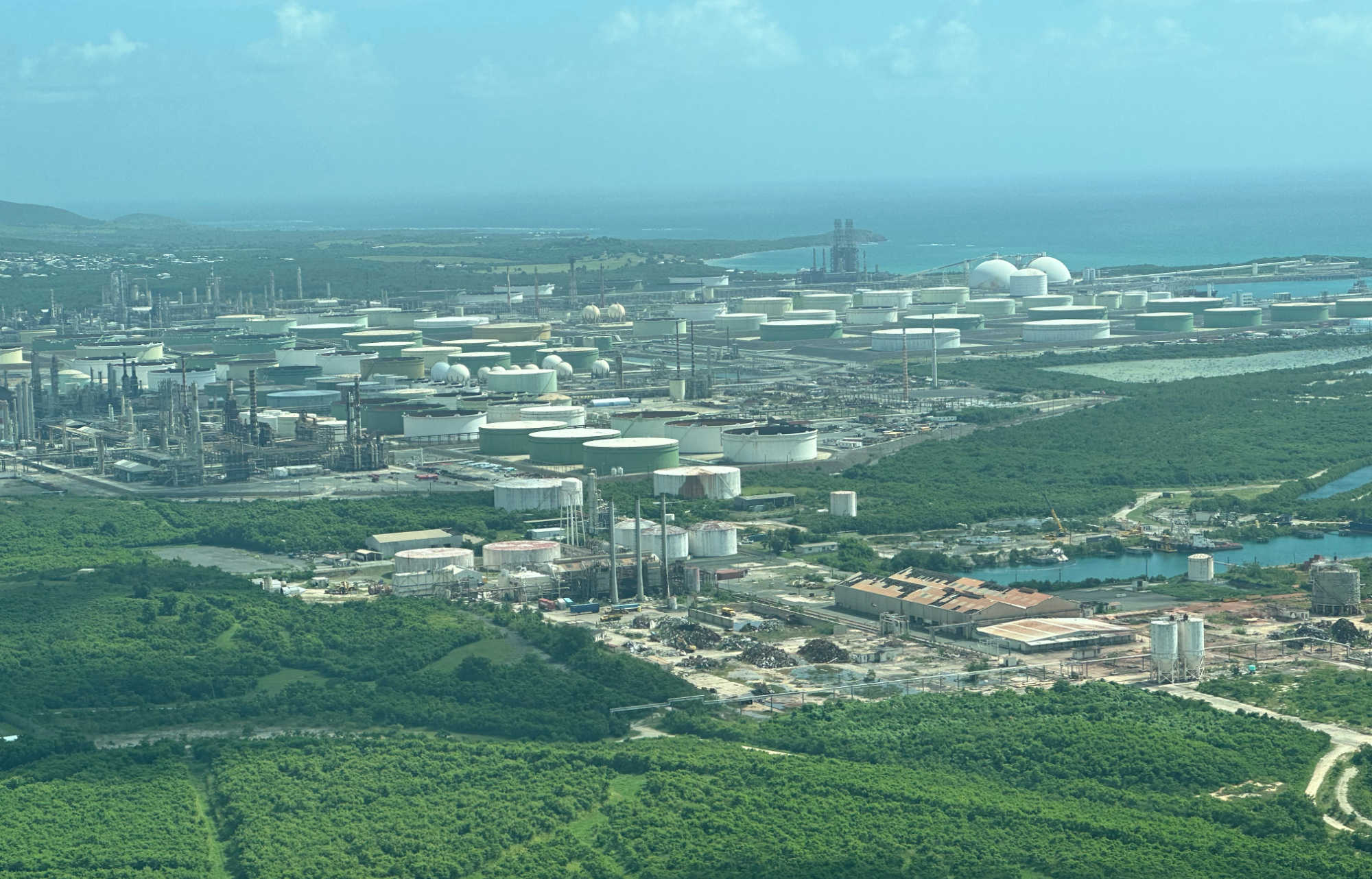
Aerial shot of the refinery and storage facility on St. Croix. Photo Credit: V.I. CONSORTIUM.

Crude oil from Venezuela, where the largest oil reserves are found, is currently being processed in Mississippi after Chevron began importing shiploads. Could the Virgin Islands be poised to do the same? The Public Finance Authority thinks it’s an opportunity worth exploring.
The processing of Venezuelan crude oil in the United States comes in the wake of the military capture of Nicolas Maduro in January. The U.S. had previously sanctioned imports of oil from the South American country, but President Trump promised to tap into the massive reserves following Maduro’s removal.
Now, refineries are processing cheap Venezuelan oil, whose price is influenced by its heavy and thick qualities, which make it difficult to process. Chevron’s refinery is designed to process that type of crude oil.
However, it is not just Chevron’s facility that possesses that capability. In testimony submitted to the Committee on Economic Development and Agriculture, the Public Finance Authority noted that the refinery on the South Shore of St. Croix was “modified specifically for processing heavy Venezuelan crude oil.”
PFA’s testimony was read into the record by their attorney, Denise Rhymer, on behalf of Nathan Simmonds, director of finance and administration.
She testified that the “apparent opening up of the Venezuelan economy and accelerated development of the oil industry presents a generational opportunity” for the redevelopment of the local refinery.
The refinery, which was once one of the world’s largest oil-processing sites, was shuttered in 2021 after an emissions incident prompted an EPA-ordered pause and subsequent bankruptcy.
In 2025, a draft proposal by the Environmental Protection Agency to repeal a key climate regulation signaled a potential opportunity for the refinery’s owners to resume operations without federal permitting hurdles.
The PFA sees its position in a hypothetical refinery redevelopment as being able to “provide support in the form of access to taxable and tax-exempt financing to oil companies that are proposing to develop and export Venezuelan crude.” The goal, Ms. Rhymer read, is to have the St. Croix refinery be “viewed by those companies, as well as by the administration in Washington DC, as a preferred destination for refining Venezuelan export into globally marketable products.”
Ms. Rhymer noted, however, that “pursuing a reopening of the refinery on the South Shore of St. Croix is itself controversial.”
Considering employment and government finances, the opening could be “attractive with respect to our long-term fiscal sustainability.” Notwithstanding, the PFA is acutely aware that some in the local community would not view a refinery reopening as “consistent with the goal of protecting the planet.”



Advertisements